Yash Chopra: Beyond White Chiffons and Picture Postcard Romances
There was more to Yash Chopra than saris fluttering in the breeze, Swiss mountains, tulip fields and pretty frames
Last Updated: Nov 21, 2012, 06:52 IST9 min
“King of Romance (1932-2012)” says the Amul ad, quick to mark a milestone in Indian history yet again. The iconic Amul girl sits on the floor of a snow-laden forest, a guitar slung across her chest, her bright eyes resting on an elderly gentleman seated before her, while the copy reads: “Main har ek pal ka shayar hoon, har ek pal meri kahani hai”, a take on a song from Kabhi Kabhie, the memorable 1976 film about ill-fated lovers, directed by Yash Chopra.
No doubt there is great poignance in that visual, paying tribute as it does to one of Indian cinema’s greatest and most successful producer-directors on his demise. In a sense, it’s apt too: After all, Chopra was a master of weaving perfect frames, pretty visuals and lyrical songs into languid romances. But, in another sense, the picture is incomplete. For as much as he has been lauded in obituary after obituary as Hindi filmdom’s King of Romance, the title fails to do justice to his vastly varied filmography that frequently showcases a forward-thinking mind, whether his audiences were ready for it or not. Romance is not an easy genre, but if we insist on pinning a single label on this man, then in all fairness let it be King of Versatility.
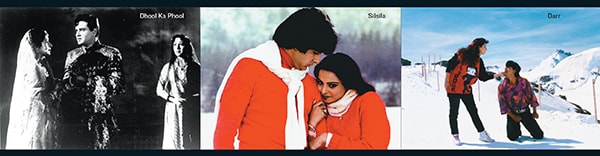
To fully grasp this idea, rewind to 1959, the year Chopra made his directorial debut. Dhool Ka Phool—produced by his elder brother BR Chopra—revolves around a young Hindu couple. While the boy is coaxed into marriage with someone else by his father, the girl discovers that she is pregnant and gives birth to a baby who she abandons. The child is brought up by a kindly Muslim man whose good intentions can do little to protect the foundling, or himself, from social opprobrium. In an India too hypocritical even today to admit that pre-marital sexual intimacy is a reality, it takes little imagination to appreciate that Dhool Ka Phool made 53 years ago was a revolutionary film.
In the years since, Hindi cinema has very occasionally revisited the theme. Each foray has emphasised exactly how progressive a thinker Chopra was all those years ago. More than four decades after Chopra’s film, Kundan Shah released the qualitatively average-in-comparison Kya Kehna, starring Preity Zinta as a college girl who gets pregnant after an affair. In 2000, the story was still uncommon enough for the subject to be described as “an uncomfortable issue” by reviewers.Imagine then an India just 12 years after independence, when the young and idealistic Lahore-born, Mumbai-based Chopra dwelt on pre-marital sex, the social ostracism of unwed mothers and prejudices faced by children born out of marriage, while also throwing Hindu-Muslim animosity into the blend. When the wounds of Partition had yet to heal, imagine the impact on the Indian psyche, of a Muslim gentleman singing to a Hindu infant: Tu Hindu banega na Musalman banega, insaan ki aulad hai insaan banega.
But Chopra would not rest there. In 1961, he made Dharmputra—also produced by BR Chopra—in which he flung himself right into the fires of pre-Partition Hindu-Muslim tensions. Here, the child of an unmarried Muslim couple is taken in by a loving Hindu family but grows up to be a Muslim-hating bigot. Dharmputra was steeped in overt symbolism and subcontinental politics. A Hindu family and a Muslim family co-existing peacefully served as metaphors for the two nations that would subsequently be torn out of one, and the hope that India and Pakistan could look beyond their painful history.
To those tempted to dismiss these scenarios as simplistic, or as exaggerated and melodramatic, it would be appropriate to point out that the release of both films would be fraught with risks even in 2012, when religious “sentiments” are still so easily “hurt”.
As it happens, the situations in both films find echoes in real life. As recently as 2011, the press reported that a Hindu couple in Hyderabad trying to adopt an orphaned Muslim baby was being harassed by both communities. The Indian secular ideal of ‘Hindu Muslim Sikh Isaai, hum sab hain bhai bhai’ is not quite the rosy reality that we would like to believe. And Chopra chronicled this truth at a time when most Hindi films preferred to pretend otherwise.
Sadly, like so many of Chopra’s hard-hitting films of the pre-1975 era, Dhool Ka Phool and Dharmputra are often lost in the flutter of chiffon saris that came to characterise his later works. That the gloss of those post-1975 films curtained off the vision of so many film commentators is partly the fault of a widespread tendency to judge books by their pretty covers, to assume that what is pretty is not gritty.
Chopra himself must take some of the blame though. Too many films released by his production house Yash Raj Films (YRF) in the first decade of this century tried to replicate the glitz that came so naturally to him, without the depth of writing that Chopra brought to most of his directorial ventures. Lustre bereft of logic—like an impoverished home with colour-co-ordinated walls and furnishings—did those films in, and Chopra cannot be absolved for such transgressions even if the reins of YRF were by then largely in the hands of his son Aditya.
There are those who believe that Chopra’s most socially and politically conscious films were the ones produced by his equally illustrious sibling. Yet, this too is not entirely true. While he owes much to his brother, his success is also inextricably linked to the great lyricist Sahir Ludhianvi to the scriptwriting team of Salim Khan and Javed Akhtar to Amitabh Bachchan whose Angry Young Man status in Bollywood was further cemented—after Prakash Mehra’s Zanjeer—by Chopra’s 1975 film Deewaar (not produced by the elder Chopra) and to Shah Rukh Khan with whom the director found remarkable box-office success from the early 1990s. The Deewaar protagonist’s angst against the system, reflecting off-screen India’s disillusionment with the establishment that had failed to deliver on the promises of independence, indicated Chopra’s ability to sense the mood of the nation. When a similar anger and violence became the norm in Hindi films, Chopra continued the trend with films like Trishul (1978) and Kala Patthar (1979) while also repeatedly breaking away with poetic odes to love.
It was with these romances that his penchant for stunning pictures came to the fore. But the enduring image of Rekha and Amitabh wandering through acres of tulips in Silsila should not take away from the courage Chopra showed in acknowledging marital infidelity in that film. It’s also a measure of how influential he had become that he was able to persuade Rekha, Amitabh and his wife Jaya Bachchan to play out on screen what many believe is the story of their own lives. Naysayers feel Chopra “chickened out” in Silsila’s final reels when the erring husband goes back to his pregnant wife, giving audiences a socially acceptable climax. The other way of looking at it though is that the film’s ending is a reflection of the most probable outcome of such a situation in middle- and upper-class real India.
It’s a different sort of courage that we see in Chopra’s 1991 Sridevi-Anil Kapoor-starrer Lamhe, applauded by critics yet a box-office failure at home. Indian audiences, it was found, were uncomfortable with the story of a man falling in love with the daughter of a woman he had once been in love with.
“Lamhe was ahead of its time,” a friend wrote on Facebook the other day. “Incest as a theme was not acceptable in the nineties.” But there was no incest in Lamhe. The girl that Kapoor’s character falls in love with a second time was not his child but the daughter of a woman he never married.
“Well yes, not in clinical terms,” my friend wrote back, “but the romance between a man and a girl his daughter’s age perhaps did not find many takers.” The box-office rejection of Lamhe is the clearest evidence of audience double standards in Chopra’s career. This was the 1990s, when Bachchan had already spent several years romancing heroines who were young enough to be his daughters in real life. The difference between Lamhe and Bachchan’s films was that the Big B was usually playing the part of a man much younger than his real age. Apparently, the pretence of no age gap between the hero and heroine was acceptable to viewers, but the fictional depiction of an age gap in Lamhe was intolerable.
In the 1960s, Chopra had earned success with the thriller Ittefaq. He returned to the genre in 1993 with the psychological drama Darr, turning Hindi film convention on its head when he made SRK’s anti-hero in effect the hero of the film. In the 19 years that followed, Chopra directed just three films: Dil To Pagal Hai (1997) starred reigning superstars SRK, Madhuri Dixit and Karisma Kapoor. 2004’s Veer-Zaara once again starred actors ruling Hindi filmdom at the time: SRK, Rani Mukerji and Preity Zinta. And Chopra’s swan song Jab Tak Hai Jaan (to be released on November 13) stars SRK, Katrina Kaif and Anushka Sharma.
Dil To Pagal Hai and Veer-Zaara were entertaining, eye-catching films that earned mega money at the box office, none of which comes easy to any film-maker. Veer-Zaara also marked a return to Chopra’s pre-occupation with Hindu-Muslim ties, this time through a cross-border love story. However, the visual grandeur, casting and excessive sentimentality of these films have clouded much of the assessment of this great film-maker’s body of work and earned some criticism from even his admirers that he had become formulaic post-Darr.
It must also be pointed out that in Veer-Zaara, like other Hindi film-makers before him who had dealt with inter-community romances, Chopra too played it safe by ensuring that the minority community member in the relationship was the girl who—as dictated by Indian social norms—could be brought over into the Hindu fold. It’s hard to tell whether there is an unspoken diktat on this matter from Indian audiences, but it’s disheartening that the man who made Dhool Ka Phool and Dharmputra would turn out to be a conformist, albeit in a well-meaning film.
Still, it’s crucial to emphasise that several films emerging from Chopra’s production house in the past decade have continued to raise significant points about the man-woman bond and inter-religious harmony. In Hum Tum, a woman is offended when her boyfriend apologises to her for their consensual pre-marital sexual encounter (such an apology would have been the order of the day in films of earlier decades). Fanaa mentions the unkept promise of a referendum made to the Kashmiri people. Sadly, the seriousness of these films is not widely acknowledged by the film-going community.
Even Chak De! India’s pathbreaking feminist tale of religious and gender prejudice in Indian sport could do little to erase the widely held impression continuing from the mid-1990s, that YRF was more about brilliant packaging than issues which resonate with India.
Indian cinema lost a colossus when Yash Chopra passed away on October 21, 2012. Good-looking stars, chiffons flying about in the wind, Swiss mountains and fields of flowers are no doubt a part of his legacy. Let’s not forget though that so too was that great mind much ahead of his time.
(Anna MM Vetticad is on Twitter as @annavetticad )
First Published: Nov 21, 2012, 06:52
Subscribe Now