Post Your Comment

Imagining Nandan Nilekani
Nandan Nilekani talks about networking, conquering new environments and playing for the long haul
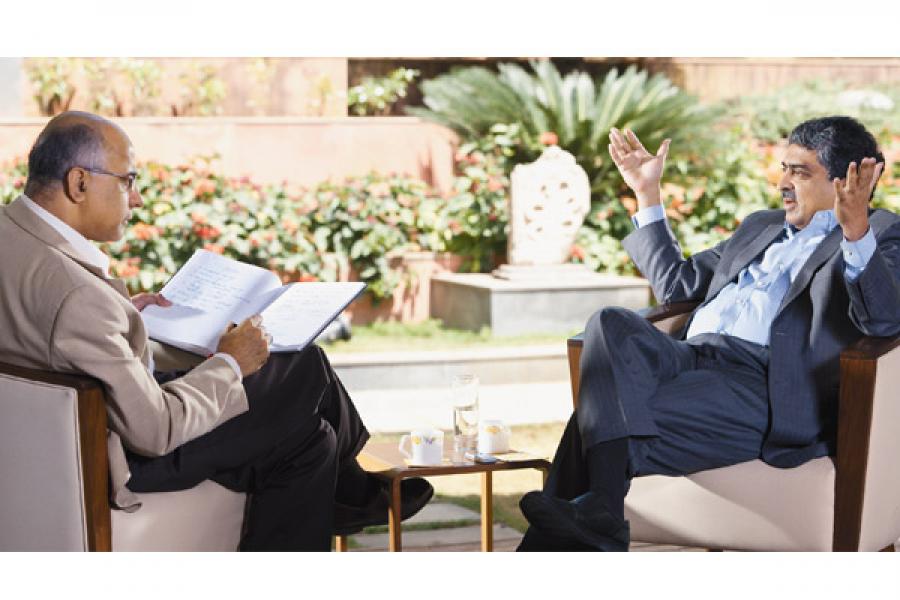
Image: Mallikarjun Katakol for Forbes India
Name: Nandan Nilekani
Profile: Chairman, Unique Identification Authority of India
His toolkit: Strong analytics, Ability to step back from the problem and look at it from another person’s view, Networking, Re-evaluating priorities and focus
I was born in Bangalore and lived there until the age of 12. My father used to work for the Minerva Mills. But soon he had to leave town because his company ran into difficulties. It was taken over by the National Textile Corporation. I was sent to my uncle’s farm in Dharwad. He was a radical humanist and a follower of M.N. Roy. I was there with him through my SSLC [tenth standard exams]. Then I spent two years at the Karnataka College doing PUC [twelfth standard exams]. From there I went to IIT, Mumbai. In the process, I became independent at a very young age. Secondly, I made a transition from a city to a small town. Because, in 1966 Dharwad was a very small town and the cultural shift for me was sharp. At my uncle’s home, I was transported to an environment of discussion and debate. There was reading and discussion on politics, society, development and such larger issues. These started influencing me even before I realised.
I think the shift from Bangalore to Dharwad, from the factory to the farm was like deconstructing yourself. A lot of people fall short of their potential because they have inherent difficulty deconstructing themselves. Deconstruction is the ability to press a “reset” button at periodic intervals.
Never thought of it like that but now that you say it, it is so true! I think in many instances I have pressed my “reset” button. From Bangalore to Dharwad and when I went from Dharwad to the IIT and then on to my professional career — it was another reset button and now this work is the latest reset in my life. So, I think my early experience gave me the self-confidence that I could go into a different environment and pull it off; that I can press the reset button.
When did you first realise your capability to do so?
It was when I landed up at the IIT. Going to the IIT was a huge thing. The guys who got in were from big cities. Academically, I didn’t do too well. But, socially I did very well — I became the General Secretary, I networked well. That was the second time when I went into an unknown situation and was able to come to the top of the heap in some sense. After that I realised that I could walk into a completely new, completely unknown environment and figure the game out. I realised I had some sort of skill and that actually freed me up completely. I felt free.
If we took Nandan Nilekani apart and looked at the parts closely, what would they tell us?
One thing is that I play for the long haul. I have a huge capacity to postpone gratification. I think that is very critical if you want any substantive rewards. People are generally impatient for the rewards of what they are doing. The second is really the Dharmik thing, which is focus on what you do and that your rewards will be your by-product. I have done it all the time. Whenever I have just focussed with full commitment, the rewards have happened. I have never asked for anything but it all comes to me.
Have you ever felt that life is about to destabilise you?
Yes, it has happened to me many times. Each time, I knew I am at the precipice, I have simply hunkered down, I have set myself to rethink everything and then I have gone back to make sense of what I am doing, to reflect on what has gone wrong here, how did I mess it up, then how do I solve the short-term problem of getting back my stability and then the long-term need of not repeating the mistake.
How does one hunker down?
You build capacity. It is a gradual, practiced process. You look at crisis in the context of the bigger goal. Suddenly, your setback does not look that big anymore. When you step back and see things in the context of your long-term goal, it helps you to re-calibrate the size of the problem. It is not that it is an inherited trait or something — I have learnt it over the last 30 years. The other thing is that I just do what I need to and I do not worry. Think of the new job I have taken up. If I sit down and start analysing the size of the challenge, I will get a heart attack! Sometimes hunkering down also requires the presence of a hand on your shoulder. And that is about the ability to receive.
Yes, indeed. I am eager to receive and eager to learn. If I meet someone and find that the individual has the attributes of the heart and the mind, I try to think how I could gain from him or her. And if you do that with all the people around, you are learning all the time.
Some people find it difficult to outgrow their mentors. Have you felt that anytime?
I didn’t grow up with a dominant authority in my life. I develop everything on my own view and experiences. I am supremely confident of myself. I don’t wait for any approvals. If I feel it’s the right thing to do, I will do it.
A little while ago, you spoke about your “toolkit”. Show us your toolkit.
I have very strong analytics. I can step back from the problem, detach and look at it from another person’s view. I constantly re-evaluate my priorities and focus. I learn from mentors constantly. I have built a huge network. My network is not just within the software industry. Through my network, I find that I am amplifying my capacity. I think the key thing for a leader is to amplify his capacity. It appears to an outsider that I am getting a lot of things done. But it is not true. I am projecting a certain vision as to what needs to be done. And, through my network, I am attracting the people who are invested in my vision and are thrilled to be part of it. So, suddenly the job looks much easier. Because it is not just me.
Tell us about how you model your network.
My model is Open Source. Ultimately, if you have a genuine interest in the other person, the bonding is immediate. That is number one. You back that up with good memory. That is not easy. If I meet a person, I recall about the person instantly. My ability to reconnect is instant. I back it up with homework. I remember when I went to Davos and was meeting with 20 chief executives, I had their full bio-data with me. I prepare for it. The other part of networking is the linkages. If I meet someone today and meet another person tomorrow, and if I feel they both can add value to each other, I link them up. There is a biblical statement, “You cast your bread in water, and it comes back to you.”
Do you feel weighed down by the expectations everyone has from you?
There is a Japanese song that “Freedom is having nothing left to lose”. I feel that “Freedom is having nothing left to prove”. That is freedom. That is the capacity to do what I have to do.
Subroto Bagchi is Co-founder & Gardener, Mindtree Ltd.
(This story appears in the 19 March, 2010 issue of Forbes India. To visit our Archives, click here.)
Comments 9
-
 Surya
SuryaWhat about the 50,000 cr wasted for this aadhar! won't you feel responsible that you have 'reset' india with this wastage of taxpayer's money!!? can someone explain how the heck india can afford thousands of acres at such a location in mysore for what is coming out? and 2 billion $ at the end of 25 years! and what is all the company is doing -- just service industry. now may i ask him, will he enjoy every fall in rupee value because the net worth of the company and future value of the projects go up?? wake up please!!
on Mar 21, 2014 -
divya
Enlightening article. Very useful to accomplish long term vision. Always a learning from resplendent people like Nandan Sir. Wish it could just go on.....
on Apr 25, 2010 -
SRINIVASAN
That was a really potent interview -- each line was a leraning for a young (or old) professional. Keep it up, Sir. I loved the "reset button" concept. Forbes might want publish a mirror interview with yourself! Just a suggestion :) !
on Mar 5, 2010 -
nalinrai
The message of the interview lies in the ability to deconstruct, that was aptly constructed by Subroto Bagchi in his question. If we only warm up to the notion of deconstructing ourselves on a regular basis, the yearn to be in the rat-race would dissipate and one would be able to contribute to the evolution of self and betterment of the society in a much focussed manner.
on Mar 6, 2010 -
surbhi
Playing for the long haul is not all that easy especially when u are new to this world but yes i do agree that networking does play a major role provided u are that manipulative and diplomatic!!!! all in all,,, well consumed statement.
on Mar 6, 2010 -
Humayun Kabir
A very good, brief peek through a brilliant mind.. that is Mr Nandan Nilekani. Wish him all success
on Mar 10, 2010 -
kusaan
Great Article !!! Good Tips to get Success
on Mar 11, 2010 -
Vijay. M
A really different and interesting take on one of the most respected and successful Indian CEOs of our times.
on Mar 13, 2010 -
Nilima
Great article. We too practice this approach but when times are bad we slip into self-pity or frustration. This article helps in building up determination to carry on. Would like to quote: "The other thing is that I just do what I need to and I do not worry." :). Would like to meet Mr. Nandan Nilekani & Mr.Subroto Bagchi in person. Thank you.
on Mar 18, 2010


