A CTO Needs to Combine Tech Expertise with Business Models
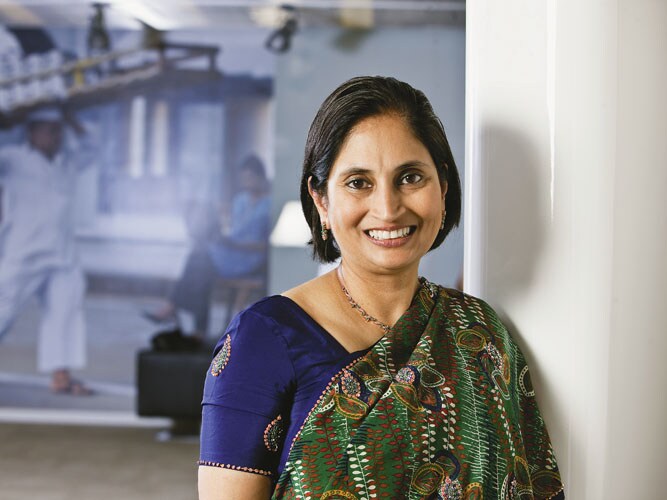
India born Padmasree Warrior, 49, is the Chief Technology Officer of Cisco, the $36.1 billion (revenue as on March 31, 2009) networking giant.
Cisco Chairman John Chambers spent nearly a year persuading Warrior to move to Cisco from Motorola, a company where she had spent most of her career. Warrior has a key role to play in Cisco’s transformation from a switches and router company to a leading platform provider for the next generation Internet. A CTO’s role, she says, is more than just looking for cutting edge products. The CTO today also needs to come up with new business models to monetise that technology. IIT-Delhi alumnus Warrior was in Bangalore recently where she spoke to Forbes India about the company’s strategy of taking the network as the platform and how it is well poised to bring together the two big trends in technology — the mobile and the Internet. Edited excerpts:
Given how quickly technology changes, how do you stay abreast of everything inside Cisco?
My role is very broad; my job is not to know the details of everything but to ask the right questions. Like do we have a lighthouse customer for SCC [the Smart Connected Communities initiative], what is our security offering in that space, making sure the architecture is connected so we are not duplicating things. It is important to have a peripheral vision and talk to people I don’t normally talk to and that’s where I use Twitter mostly. For example, I asked my 1.2 million followers on Twitter what the next generation of Internet will look like. So you can think of it like crowd sourcing for what is relevant to me. I have a very small team, I have 30-40 engineers worldwide. My role is to work with existing teams with the development organisations.
You don’t oversee the army of engineers?
Not in a direct way. Engineers in the Cisco structure are inside the product development organisation, I influence them because I am the CTO. In Motorola I had direct responsibility for engineering as well. It was more operational and internally focussed; my role at Cisco is much more strategic and much more external. It gives me the bandwidth to spend time outside which is very important now as the markets are transitioning. It gives me the freedom to work and drive changes in business models. Previously I was running engineering, I could do things but I couldn’t influence business decisions. Sometimes a technology company can struggle because they can’t get innovation into a market or into a product. I sort of bridge that gap.
Technology is changing business models. How do you cope with that?
A CTO today needs to be able to combine technology expertise with business models. Take cloud computing. While the architecture is important, the consumption models are very different. Which means how we sell what we sell is going to be very different. Twenty-five years ago when I started working, people that led technology were science officers and chief engineers. In the last five-six years, I have seen the transition. It’s not enough that you understand technology; you have to be good at thinking about the applications of the technology. You have to think about business models — not just your own but also your customers.
On an average I spend 60 percent of my time outside the company talking to CTOs and CIOs at customer organisations and visiting different markets. Being physically there and understanding the dynamics is extremely important. Internally, I partner very closely with services organisations and sales organisation, so that when they are thinking about business model changes, I can add value from a technology side.
You spent most of your working career at Motorola. What attracted you to Cisco?
(Laughs) I think John Chambers really worked at it. It took me a year to say yes. I wanted to be part of a company that can change the future in a fundamental way. How do you create the next generation Internet? How will computing architecture change? What is the role of network in that? That is so fundamental.
If you look at the last 10 years, there were two things in technology that changed our lives, the mobile and the Internet. I see Cisco as a company that can really bring the two together. That was a big attraction for me. The second is that Cisco is a very global company and we think of globalisation in a very different way. Many companies think of globalisation as outsourcing for low-cost talent or low-cost services. Whereas Cisco thinks of globalisation as a market opportunity as well as new ways of innovation.
In the past, mobile and Internet were independent industries but they are beginning to merge now. Cisco is really strong in the Internet. What does it need to do to take advantage of this confluence of the two worlds?
You need to start thinking of it as mobility, rather than mobile. Mobility is just not about the device but how can we enable applications to be available on a mobile platform. Here Cisco is positioned well because you need the network to enable mobility. For example, Webex is a conferencing solution that we developed that is usually done with a laptop and desktop with fixed Internet. We recently launched an application where you can connect into a Webex session by an iPhone, so wherever you are, you can continue to be in a videoconference on a mobile device.
Cisco has moved into so many different categories of products, from handheld video cameras, to smart grids, data centres and so on. How does one understand where you are headed from a technology or product perspective?
It is very simple, there is core networking and around that are four pillars — video, collaboration, data centre and virtualisation, and smart connected communities. Those four drive the network. Our whole strategy is around taking the network as the platform. For example, take video. We believe it will transform work, life, education. It will play a role in how cities and buildings get connected. Video is clearly a killer app. It also drives bandwidth which drives innovation in our core products. There is video all the way from user-generated video applications, which is what Flip does — it allows you to take a quick 2-minute recording and put that over which is a consumer device. We can bring it in the enterprise and allow all of us to do video blogging very easily. Supposing my team did a great job, I will send a message saying, thank you guys you did a great job, and I can send that as a text or email message. That is very impersonal, whereas if I tape myself and send it as a video message, all of a sudden it is much more personal. As if I am shaking their hand one by one.
But by getting into areas like data centres, you are now in direct competition with your partners like IBM and HP. HP has also launched a router and has acquired your competitor 3Com.
The industry landscape is changing because of convergence of communication, content, and these will lead to new types of companies competing with each other. It’s a natural part of industry evolution. We will compete with companies like IBM and Microsoft in certain areas and partner in others. All companies understand that. Cisco and HP would compete more than they would partner, because there is more of an overlap.
Cisco also has big plans for cloud computing. Do you think cloud computing will make hardware companies less relevant to the consumer? Computing will move from the desktop to somewhere far away?
It depends on the hardware that we are talking about. We think it makes the network even more relevant, because now you need the network to give you access to things in the cloud. We see cloud computing as the most network-centric computer architecture today. It will change the definition of what hardware is and how we use it. I don’t think it will be a replacement of all PCs; perhaps in an environment where a lot of workers are temporary, instead of giving everyone a PC you can do some virtual desktops. Cisco strongly believes that the world will always be hybrid. It will never be all cloud or all client. For large enterprises and service providers there will be advantages in owning a data centre, it is a trusted environment. In a hybrid model, you need things to move back and forth, and it will be the network that does that.
Cisco has invested a lot in China; some reports mention that the company has put in $16 billion in the country. What has been the return on that investment?
We invest for the long term, we are not in China and India to be opportunistic and leave after selling our products. We are in these markets to stay. We talk about not just being the best company in the world to being the best company for the world. Country transformation is a big push for us.
Yet a lot of R&D in new products continues to be driven from the West. Where can India play a role in creating the next generation product for Cisco?
It is not about East or West or developed markets versus developing markets. We have become more of a connected world, ideas can come from anywhere. We are acquiring companies outside US, and the Smart Connected Communities initiative started in Bangalore. Similarly, the physical security is being driven from here. The Globalisation Center in Bangalore is not a centre for India market, it is a centre for global markets.