Post Your Comment

Letter From The Editor: Surviving the Perfect Storm
Ironically, For me, the biggest lesson was that if you pursue customer-centricity too hard, as the Flipkart's Bansals did, it could well be life-threatening
In the last edition, I had raised the issue of how we, as a nation, need to nurture many more first-generation entrepreneurs. There is an absolute dearth of such role models in India. Which is why Flipkart, founded by two friends from IIT-D—Sachin and Binny Bansal—is the poster-boy of India’s internet economy. With the exception of makemytrip.com, there aren’t too many new entrepreneurial ventures in the last 10 years that have created—or are even likely to create—billion-dollar enterprises. Anyone who has ordered music or bought books from their site even once would testify to just how nifty their service is. And it would be fair to say that they’d be amongst the most popular online brands in the country.
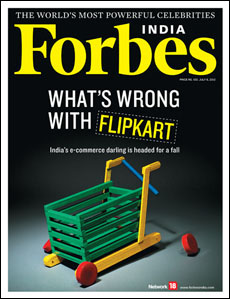
Of course, the chances are that the story could run smack into the popular—and almost romantic—perception of entrepreneurship that Flipkart represents. We’ve tried not to fall prey to that temptation.
In 2009, before we did our cover story on SKS exposing the deep fault-lines inside, it was seen as the role model for a scalable microfinance company that could help eradicate poverty. A few months later, SKS found itself engulfed in a perfect storm that it still hasn’t gotten out of.
So what’s eating Flipkart? I’d much rather that you read my colleague Rohin Dharmakumar’s story for answers. There are many lessons in starting up nestled in there.
Ironically, for me, the biggest lesson was that if you pursue customer-centricity too hard, as the Bansals did, it could well be life-threatening. Give it a thought when you turn to page 38.
Best,
Indrajit Gupta
Editor, Forbes India
Email: indrajit.gupta@network18online.com
Twitter id: @indrajitgupta
(This story appears in the 06 July, 2012 issue of Forbes India. To visit our Archives, click here.)
Comments 4
-
 Megha
MeghaThe long term sustainability and profitability of the e-commerce businesses in India whether its Flipkart, Jabong, Myntra or any other major e-commerce player is not on the agenda of their business model. E-commerce businesses hugely rely on their valuations and they all will in a couple of years exit the market by selling to a bigger foreign counterpart as soon as the FDI norms in e-commerce retail get sorted. But can they or in future the bigger better giant generate hard, real profits other than on just paper (by accounting manipulations of intangibles). That will be one mammoth task especially in a place like India where everything is readily available to the customer. The retail e-commerce in the west may flourish, but in India, customers like to actually go the market, see, touch and feel the goods, women like to shop in groups, try on several clothes and finalize one, like to bargain with the shopkeeper, majority college students swear by flea markets and other budget shopping areas. The real estate boom makes sure that every brand sets its shop at a mall nearest to your place. Indians just don\'t have a lifestyle for retail shopping online. Maybe the B2B or any other area e-commerce may prosper but retail shopping online will lose its flavour over time.
on Apr 16, 2013 -
Anonynyms
As a reader of all the current publicity and mayhem surrounding the \"epic fall of Flipkart\", I am amazed at how easily a PR job can be done so horribly wrong! If reports surrounding the Forbes article are true (or not). Flipkart\'s stance and approach (communication wise) is defensive and abrasive at the same time. It depicts an image of the company management as picky and need young guys who have NO IDEA what the communications team is up to! Firstly they write a loosely crafted email to the editor of Forbes(from a founder himself), and contradict themselves in a blog (Which is the WORST I have see in AGES). For all the damage done by the Forbes article, is this the best response the communication team can churn out??? A non-relevant-trying -to-be-funny-and-defensive blog?? As a founder of a start-up myself, I think the best lesson learnt for me here is to hire the right communication guys for the job first!
on Oct 11, 2012 -
Sumit Anand
Never the mind about Negative publicity which just got further by this conversation been published. For the consumer side, they dont care much about company\'s financials and culture as long as they are getting the price
on Jun 25, 2012-
Sandeep
But Sumit, what i understand of the impact of culture within the organisation is that it will, at one point in time or another, percolate down to the consumer. I have been buying stuff from Flipkart for over 3 years now but off-late i have started comparing prices on other websites as well, and to my surprise, i am definitely getting better deals elsewhere, and i just move to the site that offers me best possible deal. I perfectly realise that I am not the universe but they have already lost one loyal customer. I believe, it\'s the issue of the business model that the owners have decided to execute. Also, when i read the story over and over, i realised that the business was \'made-to-sell\', and that\'s something that i confirmed with a senior executive who works for fipkart. They are just working towards better valuation and that\'s about it. p.s.: I would not like them to fail and I am certain that instead of being in the denial mode, the management at Flipkart looks at this criticism constructively and prove everybody wrong.
on Jun 28, 2012
-