Post Your Comment
India and Technology Multinationals - Part 1

The last year has seen a fair amount of churn in the leadership of technology multinationals in India. Intel appointed Debjani Ghosh and Kumud Srinivasan respectively as its managing director and president. SAP elevated Suprakash Chaudhuri to acting managing director after the resignation of Peter Gartenberg, his predecessor.
In the last 30 days alone IBM appointed Vanitha Narayanan as its new managing director while CSC did the same with Neeraj Nityanand.
In IBM's case, Narayanan reports to an IBM senior executive in charge of "growth markets". He in turn reports to IBM's worldwide head of sales & marketing who finally reports to the CEO.
That's three levels of reporting layers between Narayanan, the head of a country that accounts for one out of every four IBM employees but only 2.8 percent of its revenues.
Cisco, a company that treats globalization as its core mantra and had even made India its "second global headquarters" has four levels of reporting between Naresh Wadhwa, its India managing director and John Chambers, its global CEO.
Accenture, though late to the outsourcing bandwagon, rapidly scaled its India operations to account for over 30 percent of its global workforce of nearly 260,000. And yet, it has not a single Indian among the 19 senior executives listed on its website.
That's when we decided to spend some time collating and analyzing the data of the leading technology MNCs in India to see how strategically each company was treating India when it came to organization structures and hierarchies.
For each company we collated India's revenue and headcount contribution using published sources of information, like interviews, disclosures or industry rankings like the annual Dataquest Top 20. We then tried to unravel the reporting relationships between their India heads to their global CEO and the presence of Indians* in their executive leadership teams.
Here are the results.
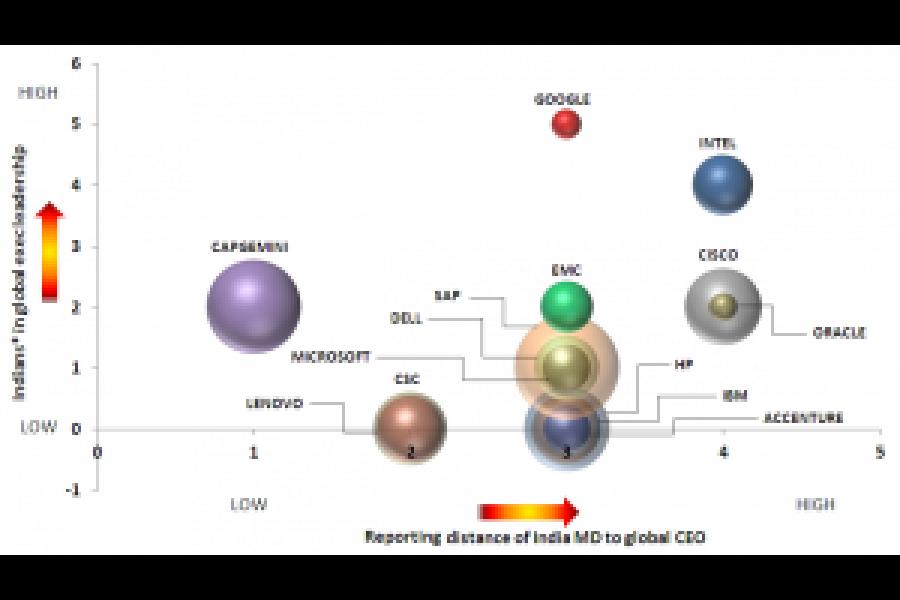
The size of each "bubble" corresponds to India's percentage contribution of global revenues with SAP India being the highest at 6.57 percent and Oracle India being the lowest at 0.45 percent respectively.
Most MNCs seem to have 3 levels of reporting separating its India MDs and global CEOs with Capgemini having the sole distinction of an India MD who reports directly to the company's global CEO.
When it comes to the presence of Indians on the companies executive leadership teams, Google and Intel are at the top with five and four respectively, even as Accenture, IBM, HP, CSC and Lenovo have zero representation.
Of course revenue isn't the only variable to analyze India's importance for technology MNCs. So let's look at the same data using India's workforce contribution as the filter.

The size of each "bubble" is now the relative contribution of a company's workforce that is based in India.
Thus Accenture, IBM and CSC immediately start standing out for the lack of Indian executives in their senior leadership, despite the fact that 25-30 percent of their workforces are based in India. Conversely Google and Intel seem to be giving disproportionate importance to Indians in their senior leadership ranks regardless of the relative sizes of their Indian workforces.
Of course, none of this implies that Indian executives should be "guaranteed" representation in their companies' senior leadership ranks, or that there should be some kind of country-based "reservation".
Which is why in part 2 of this post I will analyze the reasons why Indians seem to be flourishing beyond India in some companies, while in the others becoming the India MD is virtually a glass-ceiling. * Also includes executives of Indian origin only
The thoughts and opinions shared here are of the author.
Check out our end of season subscription discounts with a Moneycontrol pro subscription absolutely free. Use code EOSO2021. Click here for details.