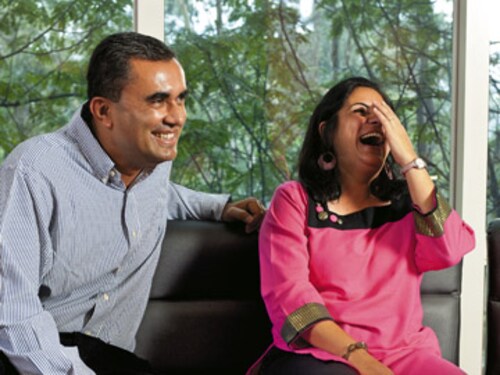
Turning down a million-dollar offer for a company that was barely off the ground was a tough call, say healthcare innovators Arjun Kalyanpur and Sunita Maheshwari, but it paid off
Arjun Kalyanpur & Sunita Maheshwari Profile: Co-founders of Teleradiology Solutions They Say:
On starting a business: Worst case scenario, it doesn’t work and you get a local job best case scenario, you create something magical.
On keeping love alive: Adopt the “vive la difference” philosophy—realise you have different and complementary strengths and exploit those differences. Be equal partners both at home and at work
Whitefield in Bangalore brings to mind images of large Information Technology companies, busloads of IT engineers, some doing great work and some leading the “two swipes and one lunch” life. In the midst of it all, quietly stands a small building with a polyclinic on the ground floor and one of the most successful global radiology centres in the world above it. Images from Magnetic Resonance (MRI) and Computed Tomography (CT) machines flow in relentlessly and a team of trained radiologists look at the many shades of grey to send out their diagnoses. It is making a huge difference to patients in advanced and developing countries alike. I am here to meet the two young medical entrepreneurs behind the now successful company, Teleradiology Solutions: Arjun Kalyanpur and Sunita Maheshwari.
After their education at the All India Institute of Medical Sciences and then Yale, where they spent nearly a decade, the two came back to India. The desire to create something new was partly born out of Arjun finding himself at loose ends even as Sunita got into the groove, working at the Narayana Hrudayalaya hospital as a paediatric cardiologist. Arjun suggested the idea of remote diagnosis to the chairman at Yale`s radiology department. What started as a pilot presented itself as a potential business. Even as he was setting it up, temptation visited in the shape of a buy-out offer worth a million dollars.
In a world where serial entrepreneurs are fashionable and the ability to sell a toddler of a business is more admired than building a company the hard way, the two had a dilemma to deal with. When someone throws money at you even when you have not achieved anything, the decision is not easy.
I have come to believe that life does not test you with hurdles. Hurdles are there merely to keep you in better shape. What life really tests you with are distractions. Money too early in the life of a company is one such distraction, even though business is about making money. It can be an exhilarating one-way ticket to obscurity. How did the two make their choice? Arjun: One of India’s big three IT companies, which was making a major foray into healthcare, approached us with an acquisition offer which seemed very tempting at the time. We did a good bit of soul searching—I felt this would be a way to secure an otherwise uncertain future. Eventually Sunita’s dad, who was an advisor to our board, gave us the best advice possible. He said a technology company should be your vendor, not your owner or employer. As a result, we said a polite “No, thank you” to the IT company.
Sunita: It was a very tempting offer as it was more money than we could ever have imagined at that point—one million dollars!—and it came at a time when the “company” was Arjun in our home guest room! It seemed like we had been handed an opportunity to do something unique in India—to throw it away for money, which we could have earned had we stayed on in the US, seemed pointless. So between me and my dad we convinced Arjun to hang on. He had a lot of fear—what if we couldn’t pull it off? So we kept discussing worst case scenarios….go back to being a doc at a hospital with a paycheck! Many years later, Arjun said he was so glad we had not sold—at that time we could never have imagined how rewarding our entrepreneurial journey would be!
Arjun is a cop’s son and Sunita, the daughter of an academic. Didn’t their upbringing come in the way of taking the plunge? To look away from the money bag and tread the path less trodden? Arjun: Yes, it certainly bothered me. I was quite comfortable in the role of an academic at Yale. When we returned to India, though, I was unable to get a decent radiology position and soon figured out I would need to create my own opportunity. Starting the company seemed like an exciting adventure, although suddenly the future was uncertain and I can clearly remember Sunita saying “Even if it flops, we can always go back to being docs.”
However, for me the reason to return was based on a firm desire to be with my parents in their declining years (both passed on in the last four years) and to allow my children to grow up in their own country. I did experience some trepidation about the move, though. Sunita was surer of her decision.
Her clear focus on wanting to be in India, doing something good for the patients of our country, made it easier for me to make the move too.
Sunita: For me, it wasn’t so much a plunge as a gradual dipping the toes in the water to later being fully immersed. I did not see myself as an entrepreneur at all—just a good doctor helping her hubby do something he enjoyed. I wanted it to work so that Arjun didn’t get frustrated in India and want to return to America! After Yale, once we realised this idea was an amazing one, I encouraged Arjun to stay in the game, kept saying that worst case scenario, it doesn’t work and you get a local job best case scenario you create something magical for India. I guess our needs then and even now were minimal—we were not driven by money. So the fear was minimal. As the company got bigger and we crossed 100 employees, then some amount of fear set in because at that point we could no longer afford to fail. For a long time, I had an identity crisis—I saw myself as only a doctor and would introduce myself as a paediatric cardiologist at Narayana Hrudayalaya. So I was a doctor from 7 am to 9 pm and an entrepreneur from 9 pm to midnight and on Sundays! It took me many years to become comfortable with this second hat that I was wearing.
One of the crucial requirements for building memorable organisations is the presence of role models, not just of material success but of an uplifting sense of purpose. Bangalore has been blessed to have many of the latter kind. Sunita and Arjun have had role models in Nandan Nilekani and Kiran Mazumdar Shaw. Nandan inaugurated their fledging enterprise and Kiran has been a collaborator ever since. I want to know what succour the duo find in these exemplars? Arjun: I think Nandan’s words when he cut the ribbon at our inauguration—“I want you to be reporting scans for every country in the world in the next five years”—were most inspiring, and have motivated us at every turn. Kiran has been a great example of elegance and class in entrepreneurship in the life sciences space. Our collaboration with Biocon has set the tone for our newest venture in clinical trials—Image Core Lab, an image interpretation and management company focussed on clinical research.
Sunita: I am half Marwari, so for me getting involved with finance, investments and other such aspects of the company seemed to come naturally. Arjun is Konkani. The Konkani community is typically not into business. So his parents were always vaguely embarrassed by their son running his own company rather than being an assistant professor at Yale or St Johns. We would always use Nandan’s example at home as someone who so ethically and beautifully built a company that India is proud of.
It is time for me to return. I want to know from the two, what is the secret of keeping love alive through the hurdles and the distractions for path creators like them? Sunita: Make sure we don’t discuss work issues when hungry or tired. Also make sure we don’t ONLY discuss work issues! A daily walk together where we catch up on kids, home stuff and also strategise for the company.
The exercise raises our endorphins and keeps us happy the discussion keeps us bonded. Ensure we do different things in the company—have our own spaces, roles and yet be there for the major things.
Arjun: Give her space and support her in her efforts, celebrate her triumphs as she does mine. Adopt the “vive la difference” philosophy—realise we have different and complementary strengths and exploit those differences. Be equal partners both at home and at work, be completely involved as a father and do my share of household chores.
Subroto Bagchi is co-founder & chairman, MindTree and is a best-selling author. His brief: Every fortnight, exchange tales of the road with successful entrepreneurs.