Post Your Comment

Micromax Mobile Advantage
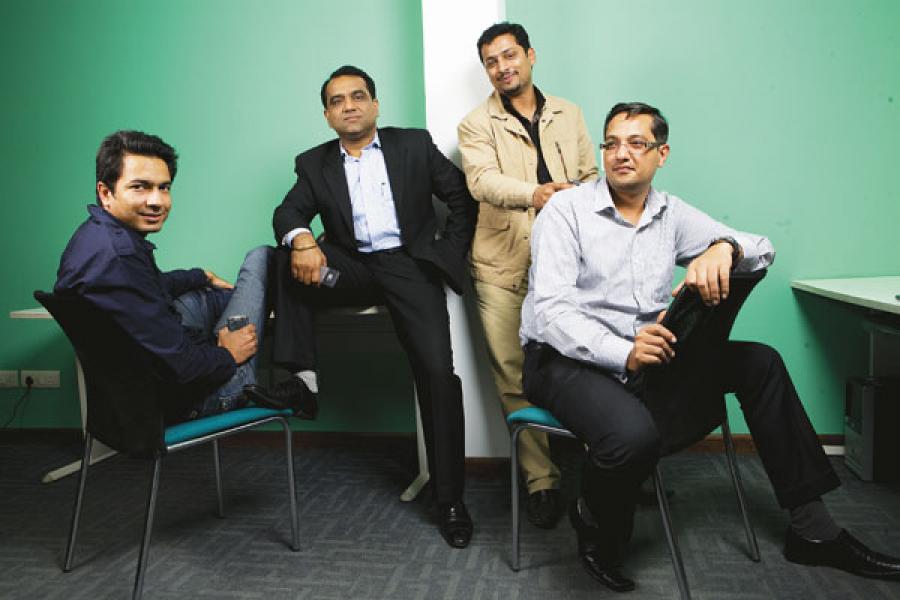
Image: Madhu Kapparat for Forbes India
AIMING HIGH: Micromax founders Rajesh Agarwal, Sumeet Arora, Rahul Sharma and Vikas Jain started making mobile phones in 2008
Four years after it was first recommended, mobile number portability still remains a paper concept. Yet for over nine months, Saurabh Raina, a 43-year-old employee with a switchgear manufacturer from Bhopal, is choosing the best monthly plans on offer across six different GSM operators while he can be reached on the same number he has had for over seven years.
This “dual-SIM” feature is today present in 20 to 30 percent of all mobile handsets sold in India, estimate experts. Yet market leader Nokia does not have a single dual-SIM handset in its vast repertoire of phone models for India. And the company that made Raina’s Q3 — Micromax Mobiles — offers this feature on 22 out of the 26 phone models it sells in India. The Q3 itself, though fancy looking, costs only Rs. 3,700.
Micromax is now India’s third-largest GSM mobile phone vendor with a market share of 6 percent after Nokia (62 percent) and Samsung (8 percent), according to research firm IDC. It sells anywhere from 700,000 to one million mobile phones every month. And by its own estimates it is now selling nearly Rs.1,500 crore worth of phones annually.
“We are not the poor cousins of Nokia,” says Vikas Jain, one of the four friends who together started and grew Micromax to its present position. “Instead we will force Nokia to launch newer products to compete with us.”
The guys at Micromax have two aces up their sleeve — a keen eye for what the customer needs, and the ability to swing their supply chain.
Though the company started making mobile phones only in 2008, it was founded in 1991 by Rajesh Agarwal as a distributor of computer hardware for brands like Dell, HP and Sony. In 1999 three of his friends — Sumeet Arora, Rahul Sharma and Vikas Jain — joined him as equal partners in the company.
Agarwal, the eldest of the four, keeps a handle on the company’s finances. The quieter Arora, a “class topper”, is the company’s chief technology officer. Jain manages Micromax’s alliances and partnerships with other companies. And the tall and fashionable Sharma is the risk taker with the big ideas.
It was Sharma who convinced the others, after nine years of selling computers, software courses and “fixed wireless” public phones (PCOs), to enter the crowded mobile phone market. The company’s first phone, the X1i, was born from the realisation that many Indian villages and towns didn’t get enough electricity to even recharge a phone daily.
Catering to a Need
By increasing the size of the battery to 1800 mAh, Micromax was able to tout a standby time of 30 days for the X1i. And at the rather affordable price of Rs. 2,150, the phone was a big success in rural India.
The unexpected success of Micromax’s first mobile phone taught the four friends two key lessons. One, “If you give people something that helps them in their day to day lives, they will buy it,” says Sharma. Two, even though there were over 50 companies selling mobile phones in India, with Nokia alone dominating over 60 percent of the market, there were features, niches and categories that could be carved out by a new entrant.
“We knew that competing on price along with Nokia, Samsung or LG would not get us anywhere. Instead we wanted to create, and own, categories,” says Agarwal.
The friends realised that intense competition among mobile operators for subscribers would inevitably lead to multiple connections per user. But carrying two phones around in your pockets wasn’t something most people fancied.
The seemingly obvious solution — handsets that accept two SIM cards simultaneously — became Micromax’s second killer category.
So Micromax decided to give a 5 percent commission to each of its distribution chain partners — the 34 “super-distributors”, the 450 distributors and the 55,000 retailers. But there was a catch — it would not offer any credit. Instead distributors are expected to complete an online bank transfer to Micromax before getting any of its phones to sell further on.
“As a result we are not plagued with dead inventory, periodic schemes or issues around “price protection”. The retailer only picks up what he sees demand for. And because their money is involved, partners tend to work harder,” says Jain.
But having a lean, cash-based supply chain means Micromax has to be much more accurate and faster in its forecasting as compared to its bigger competitors.
Naveen Wadhera, a director with the $16 billion private equity firm TA Associates, finds Micromax’s supply chain one of its real strengths. “Their time-to-market from the design to production stage is around three months as compared to the 18 months taken by larger guys,” he says. TA Associates recently acquired an undisclosed stake (though less than 20 percent) in Micromax for $45 million, valuing it upwards of $225 million.
Still there are more sceptics than believers in the company.
Disproving the Disbelievers
Its sceptics say Micromax’ rise has been fuelled to a large extent by the Indian government’s decision to bar illegally-imported Chinese phones that lacked an identifying IMEI number. As consumers rushed to replace their cheap Chinese phones, many opted for the relatively cheap Micromax ones.
Others say without a strong consumer brand or control over its own distribution, it has no competitive advantage in the long term.
One way Micromax is responding is by committing to invest Rs.100 crore on marketing over the next two years. It has also signed up Hindi movie star Akshay Kumar as its brand ambassador. There will be a new tagline — “Boring is out” with advertising designed by ad agency Lowe.
And to the charge that Micromax is a maker of cheap phones, Jain replies, “We are not even present in the sub-$30 phone market, as our cheapest phone is Rs.1,400.” That segment is dominated by Nokia with a market share of close to 80 percent.
But better responses can be found inside the buzzing Micromax office in Gurgaon. A 35-person research and development team churns out designs and prototype of new mobile phones — some radically different, some only slightly so.
There’s a sleek and shiny white square studded with Swarovski crystals which slides open to reveal a QWERTY keypad. Another sports a small clip on the bottom which is really a wireless Bluetooth earpiece which can be unplugged and used. A third bills itself as a remote control for your TV and DVD player, apart from its regular phone features.
But the most exciting of the prototypes is one called the “secret weapon”. Slated for a high profile launch during the upcoming IPL cricket tournament, it could define the next big category for the upstart company.
An excited Sharma holds the new phone in his hand, before suddenly swinging it at the laptop in front. On screen a tennis player serves the ball to his opponent. It acts like a wireless, motion-sensing controller for computer games like tennis or golf, like the Nintendo Wii.
“This phone can convert every PC and laptop from Hapur to Varanasi into a gaming device, especially for those who can’t afford to spend Rs. 20,000 on the Wii. And even if he is not into games, his kids will ask for his phone the moment he comes home in the evening,” says Sharma.
(This story appears in the 05 March, 2010 issue of Forbes India. To visit our Archives, click here.)
Comments 47
-
 Aksht
AkshtMicromax mobile is the most economical and the best I have apple,Samsung, Nokia lumina and micromax in home .Micromax is the best performing in all of them operation wise 1/year passed.
on Aug 15, 2015 -
Suresh Narvekar
dont bye micromax mobile you will burn your hands. It is dirt cheap company. I bought a mobile and for last 6 month it is for reparing only they cant repair nor give replacement for faulty products.they know only to make money.FAULTU COMPANY.
on Mar 10, 2014 -
Suresh
Micromax is dirt cheap company they dont give after sale service directors are meant only to make money they dont respond to customer feedback. My advice to public not to bye micromax brand you will bun your hands.
on Mar 10, 2014 -
Samir Nath
one year.....micormax no 1 in india...
on Jan 8, 2014 -
Shivakant
Dear ALL , I have started a blog to make people Aware of Micromax Cheap Phones and Bad Service kindly share your stories to support it ---curse-micromax-mobile.blogspot.com/----
on Dec 28, 2013 -
Shivakant
Dear ALL , I have started a blog to make people Aware of Micromax Cheap Phones and Bad Service kindly share your stories to support it http://curse-micromax-mobile.blogspot.com/
on Dec 28, 2013 -
Nikhil Jadhav
Good Team Work. However service issues needs to be tackled
on Sep 8, 2013 -
Sachin P. Surve
Dont go for the micromax canvas 2 or any other product as there no after sale service at all ...i tuk micromax canvas 2 in feb 2013 and in march 2013 i have submited it to service center because of receiver ,bluetooth and battery problem it has been now more than 25 days but i have still not received any update about my phone status the TAT of a complent which i have registered at call center is also over
on Mar 24, 2013-
Sanjay
I brought a Nokia C-5 Two years ago...It had problems with the keys and I took it to the service centre...They kept it for 3 months and after I lost my patience I was handeled back my phone...I was disgusted....If a company like nokia can do that then I don\'t lay any criticism on Micromax!! Respect your Country start ups because they add to our GDP much more significantly as compared to these outside companies like Nokia and samsung
on Jun 17, 2013
-
-
Nayan Pandya
I have bought Micromax Mobiel A57 model, this handset is continuously giving me a problem. Mostly its battery hits a lot as and when we start talking on mobile, Its drop the connectivity also in incoming calls, consuming memory a lot. I have shown this mobile to authorised service centre but they people are not able to solve the problem because Micomax appoint a local mobile repairer as their authorised service centre. I am very much disappointed about the service and poor response from the company. I must say company is very much pathetic in providing services. There is no any focus on service side just to focus on how to cheat with client by selling maximum mobiles at lower rates. There is no any access or escalation matrix also where a client gets proper feedback and solution about the complaints. I want to change this piece or give me my money back. I just bought this phone in Nov-12 hence its under warranty
on Feb 27, 2013 -
Rahul Bajaj
Never Ever buy Micromax mobile. Its a request to public all over world - Why? because micromax mobiles are such a third quality that even china made local phone are last longing than micromax phones. I have experienced micromax from its high end phones to its basic phones and really to tell you all micromax phones lasted for avg. of 3 months and then all started having problems of software, keypad, some battery blasts even. These phones are not even waste of money but dangerous too. Plus most of micromax service center persons told that don't trust cheap phones like micromax because you will be loosing money all the time reparing it so just buy new one. What a HELL micromax mobiles here....Its upto you.
on Feb 15, 2012 -
Sandeep
Its really sad that with such a worst after sales support, poor customer care and swap handset fraud practice they are fooling people. They wont replace handsets that are under warranty but will provide a used handset in place of it whether it is 10 days old handset. Their cust support says they are their boss and service center guys can be seen busy on FB and Orkut. Check their website service center numbs r wrong. Really worst company doing fraud and going to end like Satyam.
on Dec 7, 2011 -
Janakkumar Gharawala
It is a worst company which sells phone but no proper service available after sale of cell phone. I gave purchased my cell phone in Dec 2010, it stoped working in July I gave it to service center I recived unrepaired in sept, again i gave it to repair but No idea when i will get it back repaired. There is no control over the service center. Just a request to Micromax founders Rajesh Agarwal, Sumeet Arora, Rahul Sharma and Vikas Jain making cell phone is an easy task but giving good customer service is a hard task. I will never buy any Micromax product and never recomend others to buy it.
on Oct 5, 2011 -
Sirhere
The iphone like companies does not produce low range mobile phones, not the single one............. whereas the micromax, karbon like companies had produced high and low range mobile phones........ But they have made some mistakes by setting up their own standards in high end mobile phones. What i wanna say that if they produce high end mobile phones in low price then the feature should not be low in the name of high end mobile category. For example on internet after comparing micromax Andro, Karbon A1 with samsung galaxy pop s550 or LG optimus p550 i am definetly not buying the micromax and karbon mobile. If u cant make good set like others do in just 5000 then no problem, but dont waste ur valuable time in making poor sets under high end category. Instead of this try to use your time in improving your other high end high price tag mobile phones.............i know this feedback will not be publish and should not be. Cuz its just the suggestion for micromax and karbon teams............... i cant make such technical things even after doing btech in electronics........ but still if i could, then i would not waste my time in targeting and fooling cheap 5000 price tag category customers.
on Oct 1, 2011 -
Alok Manocha
Its worst company and pls dont buy any phone of this company.. even their founder is not using micromax phone.. .. coz dey know there phone is worthless and useless... i will not get this phone even if it is given free of cost..
on Sep 27, 2011 -
Alok
My personal suggestion not to buy any micromax phone... it will make your life hell... it is damn sure that you will get some problem in mobile set. if you go to service center they ask minimum 20 days to repair and after 20 days dey will keep begging for 7 more days till next couple of months... so it's better to purchase any other Chinese mobile but don't go for this company.. They don't have parts available in main manufacturing unit... Worst company... I think we should not use mobiles of this company and let them realize that we Indian are not fool...
on Sep 20, 2011 -
Mohit Aggarwal
Though micromax mobile has achieved a height but as they dont care of customer support so I dont think they can remain on top for long. Cutomer service of Micromax is worst ever.
on Aug 11, 2011 -
Chandan Kumar
Hats off to all four genius - Rajesh Agarwal, Sumeet Arora, Rahul Sharma and Vikas Jain, they are a true entrepreneur....
on Jun 13, 2011 -
Parth Saluja
These datas are absolutely wrong......there are several other mobile manufacturing companies which stand far ahead this one....and secondly the micromax mobiles are manufactured abroad and then sold in india providing huge profits to the company.
on Jun 2, 2011 -
Yashi
Nokia will still be the market share leader because it has a brand loyalty.
on Apr 29, 2011 -
Samkit P. Shah
At end when you have enough knowledge of your field, dare to think creative, dare to think to innovate something - Results will give you worth of living as owner of Micromax did in short span of life.
on Apr 21, 2011 -
Buddhhadeb Ghosh
Dear Sir/Madam I purchased W900 in this month's from Durgapur (WB). My GPS is not working properly. It was showing "the software performed illegal instruction(main). we ere sorry for inconvenience. Regarding this problem I talk to call center and your services center, no one is solving my problems. If you will thing that I am purchased this mobile and your responsibility is over, it is bad reputations for your company. Because I believe in micromax. If my problem will not solving, I can share my experience with every one.
on Apr 4, 2011 -
Sanjay Modak
This company does not MAKE these mobile phones. It imports them from China white box manufacturers. Please get this straight. Four guys getting together cannot set up a mobile phone manufacturing facility overnight. It costs billions of dollars. These guys are just canny importers of phones from China.
on Feb 16, 2011-
V E Sudharshan
Which world are you in dude??? Those were early days. And by d way Nokia and Sony Ericsson also outsources all its phones...At least they have a few plants at home as well two in my own city. So come to senses...this is what is about business
on Apr 30, 2011-
Sanjay Modak
No. You get YOUR facts right.. Nokia does not outsource all its manufacturing. They have plants in China and India and Finland and elsewhere but they are Nokia owned and operated. Ditto for Sony Ericsson and Samsung and Motorola. Some devices may be contract manufactured but by and large they are not. The Indian brands may have some final assembly plants now in India but the majority of these handsets, including the chipset and motherboard are assembled in China. Get your facts right before saying things that don't make sense.
on Apr 30, 2011
-
Sanjay Modak
Furthermore, there is no way an Indian manufacturer can today produce mobile handsets from scratch and sell them at prices that these people are selling them at. It has to be essentially manufactured in China for them to achieve these price points. That is just a simple fact. But if you want to kid yourself that these phones are 'manufactured' in India just to please your ego, then go right ahead, mate.
on Apr 30, 2011
-
-
-
Manish Sharma
VERY poor Service, bought andro after reading about company, but it stopped functioning after 10 days, returned to seller, he says will make DO and will return to company but still after 10 days no Replacement >>>>>>>>>>poor Service ..........BUY AT YOUR OWN RISK.............
on Feb 5, 2011 -
Mukesh Raut
Have taken Micromax mobile three months back but for last two months it has given toVsai (Maharashtra)service centre for repairing(Job Order No:1321 ,Customer Job card: 1018686,call no. MMX1201116071). Those people are telling that parts are not available. Last two month i am not having a cellphone & facing lot of issue. Very very upset with the MM service centre. Service center contact Person :alpesh@micromaxinfo.com
on Jan 31, 2011 -
Sachin Pratap
This comment is in context of my prev comment of 25 oct 2010. I am sorry to say but micromax has let me down.It can be successfull but can never be number 1. I have sufferred poor service in every aspect of micromax and thus micromax has lost its 1 admirer. I have my qube speaker got replaced 2 times and still its not working. Improve the service at the service centre and ask them to behave properly before its too late. i also mailed complain but no response from micromax.
on Jan 31, 2011 -
Rahul Pandit
Keep up going !! But make sure that quality been delivered as of now doesn't get a tradeoff in future to sustain the brand in the long run. I wish you guys the very best luck in soaring the market capitalisation...
on Dec 10, 2010 -
Arvind Mittal
Congratulations to you on your great success, I feel proud of you. Keep it up. Your mobiles are preferred even better then Nokia. Soon your sale will the highest sale. Regards Arvind Mittal C.E.O. , RANS Electronics, Dehradun
on Dec 7, 2010-
Manish Sharma
poor service..........this is where Indian Company lack...............
on Feb 5, 2011
-
-
Elee
Congratulate to them & a Happy Deepavali. Well I hope Micromax will give more opportunities to India design house rather to buy cheap solution from China/Taiwan. All the way Micromax.
on Nov 3, 2010 -
Sachin pratap
Its good to see Indian company finally making a mark. I really admire the way Micromax captured Indian market keeping all basic needs of people in mind. I would like to congratulate all four pillars of this company. Tomorrow is yours.
on Oct 25, 2010 -
sandeep goyal
Your Hand set Is Good But Your Services are Very Bad. Your Staff Is Very Nice and Your boss Mr Rajesh Agarwal is a VV Good man..........
on Sep 3, 2010 -
jmkarunakaran
It is impressive for every Indian to became a entrepreneur like micromax founders. Every people have their idea but they are not willing to put their effort to achieve their goal like them. Even the market is tougher and tougher but there is an opening to each and everyone to tap. Even giant like nokia wants to compete with micro max product. It shows to every one that nothing is impossible. Only thing is you have to put your soul and then any one can achieve their goal. Really micromax founders are to be role model to every one in this global village.
on Aug 28, 2010 -
Bhaskar
Amazing business strategy. Entering late in the game and forcing the leader to change rather than adapting to set rules. Rebellion at its best.
on Jul 11, 2010 -
rahul nair
great going micromax.........the position which you've achieved due to the hard work uve put in mobile making.....im also planning to buy micromax q7 next month....keep it up...:)
on Jun 15, 2010 -
Vivek
The story is quite impressive. And I am firm believer in Indigenous entrepreneur much more than, what we are seeing. However, please don't get carried always with last two years performances of any company. Companies like MicroMAX, who has gained its major market share through government game changer policy, "Banning mobile phones without IMEI number" which eventually helped the Micromax to gain this rosy 6% and sent the Chinese mobile smugglers on back foot. But Micromax should not forget that there similar copycat are there and their plans may outnumber Micromax number in next two year. It is obvious as per any game theory analyst prediction.<br /> <br /> No doubt over the growth in two years is impressive, but we should not forget the service quality is matching at all with expectation. Even though today Micromax controls 6% market share and competing with Nokia and Samsung (so called). I would like to suggest all gentlemen at top to take strategic move from here onwards. Otherwise by ready to see PE money eroding your company value and ending up in distress sale! <br /> <br /> These remarks are my personnel observation and no conclusion should be drawn, thanks<br /> viveksuman.wordpress.com
on May 19, 2010 -
Devendra
We have purchased the Micromax Handset (X360) on Dt: 5 April 2010 however after three days, this set is not working properly and continue showing the hand free symbol in display of Phone. Due to we are not able to make a call from last six to seven days.<br /><br /> <br /><br /> When we have visit the two to three Micromax service center 8 to 9 times however not result found at ground and pls confirm that what mistake we have done to purchase the Micromax Mobile. Moreover we have made the call on following number of micromax which micromax has given your warranty guide & website however all the Phone are Dead, Not reachable or not adjust<br /><br /> <br /><br /> Corporate office No :01244009601/02 (Number Busy from last Four hr)<br /><br /> Insta. help for GZB (According to your service guide) :9958309336 (Incoming facility not available)<br /><br /> Insta. help for Gurgaon (According to your service guide) :9971997112 (Switch Off)<br /><br /> Nos. received form your Shahadra service center through Phone : 01145082591/92 (Number not reachable)<br /><br /> Your Call center no :18605008286 ( Call received after three Hr continue calling)<br /><br /> <br /><br /> In the view of above, still my problem has not been resolved and we have faced very bad experience with Micromax
on Apr 18, 2010 -
vishal
Its very nice u people r working very hard, and made MICRO MAX a national brand. I just want 2 add one thing in ur handset that is give a option in msg MY FOLDERS,in which a person can catogerise his/her inbox msgs like;personal msg,credit card msg,bank a/c msg etc. so that he/she can easily search his/her msgs in short time.<br /> Thanks
on Feb 27, 2010 -
Amrit Malhotra
MICROMAX success depends on its team effort & the way they are managing there inventory & cash flows.
on Feb 28, 2010 -
Praveen
The success of mobile vendors like Micromax & Karbonn is due to the absence of NOKIA in dual sim market. If NOKIA starts doling out dual sim handsets you will not find these vendors anywhere in market. But the big question is why NOKIA is restraining itself from dual sim handsets????
on Mar 1, 2010-
Sudharshan
First of all, dual-sim becomes very expensive for nokia to produce. Infact their cost of production is very very high. That is why all the companies take on nokia on its price and its inflexible features. And trust me in next few years they have to pack up and out of india.
on Apr 30, 2011
-
-
ankur sharma
Micromax is very good mobile
on Mar 2, 2010 -
Satya Manu
Micromax is leading the way up in the cut-throat competition of mobile phone market. Soon it will acquire a bigger share in the mobiworld.
on Mar 5, 2010 -
Vijay Patel
Senior guys at Nokia must read this story. They will discover where they are missing. I think their people are smart enough to understand. I am a big time Nokia lover but still wish Micromax all the best as they will make them think.
on Mar 11, 2010