Across USA - The Call of the Road
The automobile and the USA it's been a long love affair. And what could be more American than a good old-fashioned road trip?
Last Updated: Jun 28, 2010, 06:08 IST7 min
Road trip.” That’s all I needed to say to my friend Eileen. A week later, we piled into my 1986 Toyota Camry and headed out of Los Angeles. Destination: Home, Chicago, 2,112 miles away. The Camry was as old as I was — in fact, a mechanic had pronounced it incapable of making the trip — but there had been no question of whether I would take it with me.
The cult of the road trip in America boils down to this: We love our automobiles. A mere 8 percent of us don’t own a car. When automobiles first came out in the early 1900s, critics said it would be better to just get yourself a horse. But, as American political satirist P.J. O’Rourke has pointed out, the automobile did get a horse for everybody. My Camry was my horse, and I loved it deeply, for its automatic seatbelts, deep furry seats, cassette tape player, and the right-hand window that could only roll down halfway.
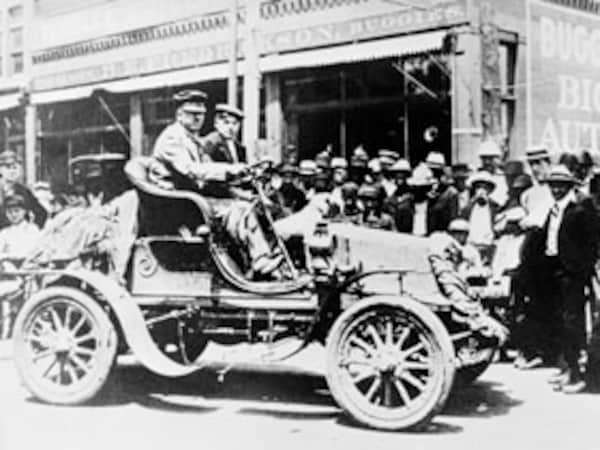
H. Nelson Jackson, a San Francisco doctor, was another American who really loved his car. In 1903, he bet his friends that he could drive his two-cylinder Winston Automobile (he called it “Vermont”) all the way across the country.
At that time, the only modes of travel were horses and railroads. No one had ever done a cross-country road trip before. He set off with a friend who doubled as a mechanic, and a dog named Bud. Vermont got a gas leak in Oregon. They had to drag the car at one point, get it towed by a horse at another. But 63 days later, Jackson smugly collected his $50 bet.
The Great American Road Trip as it exists today is bound to be an adventure. The weird people you meet and the heartland food, the changing landscape, the car troubles, figuring out maps and managing the little money you have. And singing along to the music, loud, the whole way.
We hoped to make it from LA to Chicago in three days. That is, if we made it at all. Neither of us said it, but I knew we both thought the Camry wouldn’t make it. So when we drove the first 270 miles from LA to Las Vegas without a hitch, we laughed, delighted to be wrong.
Around the time Jackson finished his cross-country road trip, Henry Ford’s Model T cars started rolling off his famous assembly lines more than 15 million from 1909 to 1927. Americans were happy to ditch the railroads for their own personal horse. The automobile became a member of the family. Like Jackson, Americans gave their cars names I christened my Camry “La Cienega”, after a street I loved in Los Angeles.

Driving La Cienega out of Las Vegas, Eileen and I imagined ourselves like the family in Grapes of Wrath, but setting out in the opposite direction, back from California, because we’d already seen the Promised Land. Or like Dean Moriarty and Sal in On the Road, though we didn’t have the guts to try the drugs or antics they did. No, we decided, we were more like Thelma and Louise. Two young women trying to escape our lives with a little bit of adventure.
Ah, adventure. As we entered Death Valley, the lowest, driest, hottest place in all of North America, La Cienega began to tremble. We should have known she couldn’t take the desert heat we could have driven around it. But we were determined to take the speedy 15-70-76-80 interstate route, which cut straight through the valley.
Eileen and I kept pushing it. Brave La Cienega huffed and puffed until the middle of the valley. And then she went into a coma.
“S**t, I think she’s overheated,” Eileen said. “What do we do?” I asked in an unsteady voice, feeling for La Cienega as if she was my child in hospital.
We popped the hood and poured coolant in the engine. La Cienega didn’t move. We put in water. More coolant. Still nothing. We tried to wave down a car, a truck, anything, but there was endless desert around us. Some vehicles passed, but no one stopped.
After three hours in the sweltering sun, we stripped down to just our bras and shorts. Partly because we were hot, but also because Eileen pointed out we could better wave down a bus driver that way.
We had made good time, having reached Death Valley from Los Angeles in just six hours.
Alice Ramsey, the first woman to cross the country by car, took 59 days from New York to San Francisco in 1909. Then again, with only 152 miles of the 3,600 miles she travelled paved, it wasn’t easy. Not to mention changing 11 tires, repairing a broken brake pedal, cleaning spark plugs, and sleeping in the car after it got stuck in mud. But I’d bet she didn’t mind — it’s likely she was just as crazy about her automobile as Jackson or I was.
“Grrrrhhhph,” said La Cienega. “Grrrrhhhphhhhhppphh”, and she came to life.
“I knew you could pull through!” I shouted, giving her a happy slap on her hood and jumping behind the wheel.
Colorado. Death Valley was a distant dream. We were surrounded by the craggy spires of the Rocky Mountains. We felt incredibly tiny in our already tiny car. And we were utterly alone.
“Wow,” I said, and could say nothing more. “I know,” Eileen said. “I know.”
I saw the hungry look in her eyes, and let her drive. There is nothing like hugging the curves of the mountain roads, feeling your automobile dip and rise beneath you. La Cienega was still jerky, spluttering at times, but it didn’t matter this was bliss. By sundown we got to Boulder, haven for hippies and pot-smokers.
In the morning, we trundled back onto Interstate 76 and headed for 80 where we’d hit Omaha, Nebraska. We’d chosen 76 because it was faster and easier than Route 66. Not without a pang of regret: Route 66, after all, was the iconic road trip highway.
“It’s gonna be all flat land,” Eileen warned me, “Let me know if you’re about to fall asleep.”
I knew I wouldn’t get bored or sleepy. I was still enchanted by the endless stretch of open road. It wasn’t Route 66, but I found enjoyment in discovering the almost imperceptible changes in the land, in the small markers that displayed how many miles were left, in the funny town names. Rawhide! Valentine! Tincup!
We were deep into Nebraska now, and it was getting dark. “Stop?” Eileen asked, and it had been exactly what I was thinking. Your thoughts tend to collide when you’re in the car together for long enough.
We tried to stop in a local bar for a beer and some food to shake off the day of driving. But the bar was full of grizzled men with mullet haircuts, their eyes glazed from too many days in a row drinking. We ate at a greasy Midwestern America diner down the road instead — French fries, a greasy burger and fried chicken. We stumbled back to our hotel room in a food hangover, not caring that it smelled of smoke or that the bed’s sheets were stained from some earlier love affair. We collapsed into bed, content.
After threatening not to start at all, La Cienega spluttered to life. The airconditioner now barely worked. The music player went on and off. Performance was pathetic. Americans — men particularly — love performance machines with horsepower and muscle. I loved the Camry despite its lack of both.
Eileen and I were groggy, maybe a little hung over, eyes watering from the endless staring at the road. We joked less, the silences stretched longer.
At this point in their journey, the family in Grapes of Wrath were down for the count, with two dead, two who’d jumped ship. In On the Road, Sal had spent so much time with Dean he’d realised what a “rat” he was and they were about to separate. As for Thelma and Louise? On the run from the law, they were approaching their tragic end.
Eileen and I weren’t dead, separated or on the run from the law. But the last 1,000 miles and 15 hours were rough. I could feel La Cienega telling me she didn’t have much left in her.
When we finally pulled into my driveway, we were quiet.
Then: “We made it!” we both shouted, together, laughing.
There was just one thing left, an itch in the back of my mind. I had to go back to college in Boston in a few weeks. I turned to the passenger seat, and knowing La Cienega was listening too, I asked Eileen, “Up for one more road trip?”
First Published: Jun 28, 2010, 06:08
Subscribe Now(This story appears in the Nov 08, 2019 issue of Forbes India. To visit our Archives, Click here.)