Back To The Roots For Andhra Pradesh Farmers
Traditional practices can revive tired soil and pull small farmers out of debt. Andhra Pradesh shows the way
By Udit Misra
Last Updated: Oct 06, 2010, 06:36 IST12 min
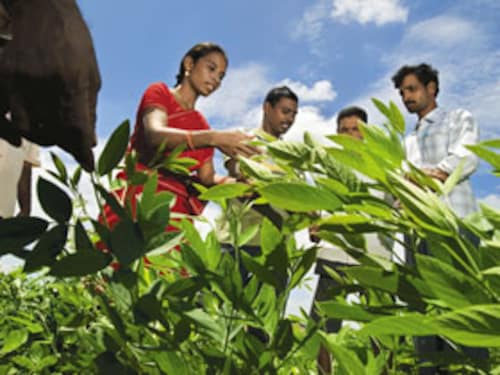
Nineteen-year-old Meenakshi was sure about the way forward, but she had to convince her husband. She tore a sheet of paper and asked him to sign it. It was an unusual contract. They would split the land they had leased for the season — about one-fourth of an acre. They would farm it in their own ways and see who makes more money at the end of the season. If Meenakshi won, her husband would shift to her way of farming.
It was summer of 2004 and Meenakshi, a landless tribal girl from Koduru village in the Srikakulum district of Andhra Pradesh, was convinced that the only way for her to change her debt-ridden life was by changing the way her family practiced agriculture. She was part of a women’s self-help group and had seen positive results of a cheaper, more sustainable way of farming that the group had been promoting.
As was the case with many farmers in Andhra Pradesh, Meenakshi’s family was always in debt. Farming was no longer remunerative and their meagre earnings were spent paying back the interest on the loans taken to purchase chemical pesticides and fertilizers, which accounted for over one-third of the total cost.
That summer, under the guidance of her self-help group, she used locally available resources like cow dung and traditional knowledge of controlling pests. She reaped a profit of about Rs. 15,000 — Rs. 5,000 more than her husband.
A Small Revival
Meenakshi’s stunning success was part of early experiments in a revolutionary approach to farming in Andhra Pradesh, called Community Managed Sustainable Agriculture (CMSA). Launched formally in 2005 by the Ministry of Rural Development in Andhra Pradesh, CMSA presents a bold alternative to conventional input-intensive agriculture in a state that has the highest consumption of pesticides and fertilizers in the country.

For example, Meenakshi uses Ghanajivaamrit, a mixture of cow dung, cow urine, jaggery, gram flour and microbes-rich clay. Over a one-acre farm, such a switch could bring down costs from Rs. 2,200 to just Rs. 200.
The need for such a programme was clear. Over the years, indiscriminate use of pesticides and fertilizers had degraded soil health. As a result, yields began to stagnate through the 1990s. Coupled with high cost of inputs, that spelt doom for small and marginal farmers in the state. Such farmers own less than 10 acres of land and account for roughly 85 percent of all land holdings. Incidence of farmer indebtedness continued to rise agricultural woes have made Andhra Pradesh one of the hotspots for farmer suicides in the country. An estimated 1,688 farmers committed suicides between 1997 and 2004.
So far, CMSA’s results have been heartening. The cost of cultivation has come down by 30 percent to 40 percent. According to one estimate, net incomes on per hectare (or 2.5 acre) basis ranged from $2,520 to $4,032 per annum — a remarkable increase given the fact that earning of the landless poor in India is less than $1 per person per day.
Today, CMSA is being followed by over 3 lakh small farmers spread over 3,000 villages in 21 of the 23 districts in Andhra Pradesh. It is no surprise then that it has caught the attention of agriculturists and politicians alike. M.S. Swaminathan, who led India’s Green Revolution in the late Sixties, likens the CMSA initiative to an “Evergreen Revolution” since it focuses on sustainability of the soil and profitability to the farmers. Buoyed by the possibility of reducing environmental damage, environment minister Jairam Ramesh suggested the agriculture ministry take a close look at CMSA practices. From the Union Agriculture Ministry to the Food and Agriculture Organization of the United Nations, many are trying to understand how CMSA made it happen.
How the Model Works
The CMSA model has broken the myth that small farms are not remunerative,” says T. Vijay Kumar, an IAS officer who spearheaded the CMSA initiative as the CEO of the Society for Elimination of Rural Poverty or SERP, a non-profit entity set up by the state government. “When we started out, our key concern was to make farming remunerative by reducing the input costs without compromising on the yields,” he adds. He has recently joined as joint secretary in the Union Ministry of Rural Development and hopes to assist scaling up CMSA at the national level through the National Rural Livelihood Mission.
Rural livelihood programmes under SERP, like CMSA, are financed by the World Bank. CMSA is additionally financed through community savings and other state and central level programmes like Swarnjayanti Gram Swarozgar Yojana and Rashtriya Krishi Vikas Yojana.
The key to CMSA’s success is the community participation. The model’s approach is ground up in any village CMSA starts by the formation of a farmer self-help group (SHG). Here, the existing women SHGs of SERP come in handy. Each SHG typically has 10 to 15 women. Each member pays a small registration fee which adds to the overall corpus of CMSA for internal credit purposes.
Once part of the system, farmers receive extensive guidance by more experienced farmers like Meenakshi. SERP too provides them with knowledge and capacity building services.
“We subsidise knowledge instead of fertilizers and pesticides. Teaching Meenakshi and letting her teach others like her is the best extension service model [which helps extend knowledge to more and more practitioners],” says D.V. Raidu, the state project advisor for CMSA.
Today Meenakshi is one of the 63 state-level Community Resource Persons (CRPs), the highest rung of extension workers. “I teach from my own experience and that is why I can address the doubts and problems of the farmers,” she says in Telugu.
Meenakshi’s success story best captures the change being brought about by the CMSA initiative. Six years on, her husband has stayed true to the contract and together they now lease and farm 2 acres. The next step is to own a piece of land for which she is saving.
Like Meenakshi, many farmer households have been able to come out of their chronic indebtedness thanks to CMSA.
According to one survey of five districts, quoted by Om Rupela, a former principal scientist with Indian Crop Research Institute for Semi Arid Tropics, 386 out of 467 (83 percent) farmers have reacquired their mortgaged lands by using the savings after two years of practicing CMSA.
CMSA is not only helping subsistence farmers come out of their debt trap, but is also showing them the benefits of a market which pays a premium for better quality.
Rajshekar Reddy Seelam, managing director of Sresta, a Hyderabad-based company that sells organic food products both in India and abroad, is another such believer. By the year-end he is set to roll out a new brand selling products out of CMSA farms, conforming to international standards.
“We believe that in 10-15 years, the market for such products would be around $5 billion just within the country,” he says.
The Bigger Picture
The story in Andhra Pradesh is not too different from what happened to agriculture in the rest of India, especially areas like Punjab, where Green Revolution was implemented in the largest measure.
By the start of the 1990s, agriculture in the country had started choking on its initial success, giving rise to two broad sets of problems: Stagnant agricultural yields and increasingly un-remunerative farming.
Over the 1990s, almost imperceptibly, the whole system became lethargic. The extension services of the government started to fall apart. The key function of such services is to bring the farmers up to speed with the new technologies being perfected in the labs and guide them in adopting these. Meanwhile, farmers, influenced by local moneylenders and pesticide sellers, resorted to indiscriminate use of chemical inputs. Every passing year, the soil became progressively less responsive, all the while raising the stakes to a point where even a single crop failure tipped the farming household into chronic indebtedness.
Today, rural indebtedness in Punjab, one of the best agricultural performers of India, is three times the national average.
The importance of this issue can be gauged from the fact that the National Policy for Farmers (2007), the main agricultural policy document in the country, states, “There is a need to focus more on the economic well-being of the farmers, rather than just on production. Socio-economic well-being must be a prime consideration of agricultural policy, besides production and growth.”
On the other hand, the decadal growth rates of yields for the two most widely produced crops have continued to fall since 1980s. For example, Wheat yields grew at 3.10 percent during the 1980s, 1.83 percent during the 1990s, and just 0.58 percent during the 2000s. The story is largely the same for most of the other crops.
Official data shows how these stagnant yields affected India’s increasing population over time. The net availability of rice has fallen from 81 kg per capita per year in 1991 to 53 kg in 2008 while that of wheat has fallen from 60 kg to 53 kg per capita per year over the same period.
The distinction between the two broad problems is important since the very policies and tools that were supposed to increase yields were also responsible over time for aggravating farmer indebtedness. But there is no doubt about which is the bigger problem for those promoting CMSA.
“We believe that until agriculture becomes remunerative, even the food security concerns cannot be met,” says Kumar.
Necessary, but not Sufficient
So can the CMSA model ease the agricultural distress in a country where 60 percent of the population, roughly 700 million, is still involved in largely un-remunerative agriculture?
The short answer is yes.
But there are still some doubts whether CMSA can solve the other riddle of raising yields.
Not even the chemicals company representatives deny the inherent wisdom of the CMSA approach. However, there are a few qualifications.
S.K. Khosla, advisor, CropLife India and Rajen Sunderesan of the Agrochemicals Policy Group agree that there has been excessive use of chemical inputs by farmers. However, they blame it on the failure of the extension services which has allowed “a gap of 20 years between the technological frontiers and the farm.” With India’s extension system in tatters, farmers continue to implement obsolete technology and methods.
Matching yields in the short term is one thing but “Will this system allow for higher yields in the years to come?” asks Sunderesan. “If it can, only then should it be promoted,” he says.
What he means is that more output cannot be achieved without more inputs. At present, there is an imbalance in the soil that needs to be restored and CMSA is doing just that. However, once this is done, newer varieties of seeds would need more nutrients to give better yields. The way seeds technology functions is that every new variety is capable of taking up more nutrients from the soil and converting it into food. Without any assistance in the form of chemical fertilizers, newer seed varieties will not be able to produce more from the same piece of land.
Agrees Suresh Babu, senior research fellow at the International Food Policy Research Institute, “Without increasing inputs, it is not clear whether yields will continue to increase in the longer term.” Swaminathan too feels that once the imbalance in the soil is addressed, it would be best to make use of chemical inputs.
Babu believes that while CMSA resolves the indebtedness problem, there is no guarantee that the farmers will not rush back to using pesticides in case of a major pest attack.
“Organising people is the key to CMSA’s success but that is also the main hurdle in replicating this initiative in other states,” says T. Nand Kumar, a former Indian agriculture secretary and currently the chairman, Commission on the Optimum Use of Fertilizers.
In his budget speech this year, the finance minister, Pranab Mukherjee, announced the extension of “green revolution to the eastern region of the country … with the active involvement of Gram Sabhas and the farming families”. Irrespective of whether CMSA can be replicated elsewhere in the country or not, one thing is certain: It will provide some key markers to ensure that the second green revolution in India is more sustainable than the first.
A Bug’s Life
How an understanding of the life cycle of pests helps protect crops

It’s easy enough to spot a CMSA field. As you approach the small handkerchief plot nestled among swathes of lush fields, you first notice the buzz. As you get closer, you see the source of the buzz: Dragonflies and birds — the little plot is teeming with them.
You also notice that unlike the other farms, the crop lengths here are varied. It almost looks like an oasis surrounded by regular fields. For instance, in Kurnool district in Andhra Pradesh, a typical CMSA farm has every two or three rows of red gram (tur) interspersed with one row of castor, unlike a non-CMSA farm which has a mono-crop of red gram. The whole plot has a hedge of corn plants, and if you look closer, it is only on a CMSA farm that you will find ladybird beetles, cosily ensconced in the leaves of the corn plants.
The reason for these varied crops is simple: The ladybird beetle feeds on the pests that attack red gram and castor. Besides, the corn plants provide protection from pesticides used on adjoining farms. “Castor attracts the pests that would have otherwise attacked red gram,” explains Meenakshi. So instead of spending a lot of money on repeated sprays of pesticides, farmers just spend some time every week plucking castor leaves where the pest has laid eggs.
So for crop protection, CMSA relies more on understanding the behaviour and life cycle of the pests attacking a particular crop.
No mechanisation, no health hazards due to pesticides, no side effects for the soil and the environment, zero costs for the farmer and a more nutritious yield of red gram. For the same volume of rice the CMSA produce weighs more. So if a jar full of conventional rice weighs 1 kg, a jar full of CMSA rice weighs about 50 grams more.
The second important aspect of CMSA consists of a comprehensive strategy to improve soil health. “Plants don’t eat chemical fertilizers by spoons. It is an organic process which must be respected otherwise the soil will stop responding, as indeed it has,” says D.V. Raidu, the state project advisor for CMSA.
But CMSA is not merely the replacement of a few chemical pesticides and fertilizers by cheaper options. CMSA isn’t organic farming either. Essentially, its appeal lies in its practicality in a country where landholdings get smaller with each passing generation.
“Frankly, we do not teach anything that is not already a part of the Integrated Pest Management and Integrated Nutrient Management techniques accepted by the government. The trouble is, nobody cares to follow it,” adds Raidu.
First Published: Oct 06, 2010, 06:36
Subscribe Now(This story appears in the Oct 08, 2021 issue of Forbes India. To visit our Archives, Click here.)