Kumar Mangalam Birla: A Man For All Seasons
Kumar Mangalam Birla, who stoked the acquisition frenzy in 2007, hasn’t budged even when all’s not well with the economy
By Cuckoo Paul
Last Updated: Oct 04, 2012, 06:49 IST14 min
Award: Entrepreneur for the Year
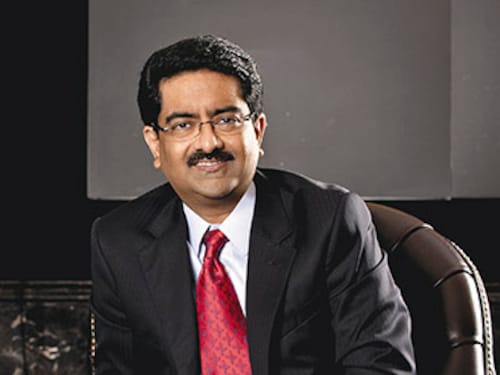
Name: Kumar Mangalam Birla
Chairman, Aditya Birla Group
Age: 45
Why He Won: For changing the profile of the century-old conglomerate, earlier dominant in old economy segments. For entering new businesses and for gradually increasing international operations and geographic spread, through mergers and acquisitions.
What you are is a creation of the choices you’ve made until now. What you will be is a function of the choices you make today. For all practical purposes, it sounds like an immutable truth. Because there seems little else that explains the likes of Kumar Mangalam Birla. Why is the man who presides as chairman of the Aditya Birla group where he is now? And why is he driving the group into making the kind of choices it is today?
To put things into perspective, in the buoyant year that was 2008, Indian entrepreneurs seemed a frothy lot. The business press was bursting at its seams in trying to document stories of their ambitions and frenzied action in corner offices. Companies based out of India were trying their damndest best to acquire or merge their assets in other parts of the world. It was “India Shining”, many said.
Birla was among the first who stoked the frenzy. In February 2007, he announced his group would pay $6 billion to acquire an American company, Novelis. Debt-ridden and in distress, Birla thought it a good time to buy the world’s largest aluminum-manufacturing company. In a text-bookish statement, he then said, “It is in line with our long-term strategies of expanding our global presence across our various businesses and is consistent with our vision of taking India to the world.”
Be that as it may, coupled with Tata’s landmark acquisition of Jaguar Land Rover a year earlier, that was perhaps the reason why in 2008, 1,270 deals with Indian participation were announced. Research and Markets, a firm that tracks such activity across the world, computed the total value of these deals at $50 billion. For a while, all looked pink and pretty and a world dominated by companies from emerging markets like India seemed inevitable.
It is a while away before numbers for the current year are computed. Anecdotal evidence indicates that though the emerging markets theory continues to hold good, all is not well. It is not uncommon to hear Indian entrepreneurs use a quaint term to describe their current predicament—an ‘investment holiday’!
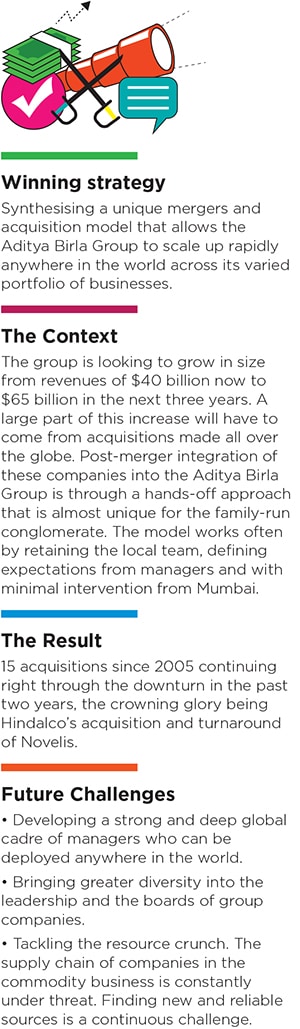
But it is an alien term in the corridors of the group’s Mumbai-based headquarters. On the contrary, Kumar Birla wants turnover to touch $65 billion by 2015 from the $40 billion it is right now. While the goal was set during more sanguine times, Birla refuses to budge. In fact, as recently as this May, he announced the group’s intent to acquire Pantaloon Retail for Rs 1,600 crore. The proposal is pending regulatory approvals. “Our success rate on M&A is 85 percent—this is for results that have exceeded our benchmarks,” claims Dev Bhattacharya, the group head for corporate strategy.
Given this kind of numbers, we thought it an interesting exercise to dig deeper into the choices Kumar Birla exercised in the past to understand what his future could look like.
Choice #1: Persist
When Kumar Birla was 34, a Barcelona-based acrylic fibre company showed up on his radar. That was in 2001. This was the kind of company the group would do well to acquire. His team put a proposal in place and shot it off. But those were the days when Brand Birla was unknown outside India. And so their calls went unanswered. When they finally got through, the chairman of the Barcelona-based firm thought it a pointless exercise and gave the meeting a skip. Instead, he sent a junior executive to find what the ‘upstarts’ had in mind. Nothing came of the meeting.
On his part, Birla kept his head and thought waiting it out was a good idea. Two years later, the firm went bankrupt and the Indians had an awfully good time picking and choosing from the debris assets they thought would be useful to their business.
While it is easy to think of the Barcelona-based chief executive as myopic, fact is, he was going by his perception of the world—companies that originate from emerging markets like India are bottom fishers out to squabble for a cheap deal. He wasn’t the only one.
Around the same time, Columbian Chemicals was up for sale. Birla told his team that if they got Columbian, then owned by US-based Phelps Dodge, they would be the world’s largest manufacturer of carbon black—an ingredient used to manufacture automobile tyres. But because the Americans didn’t have a clue about Birla, his executives weren’t as much as granted an audience and Columbian was auctioned off.
But the company refused to go off Birla’s radar, and in July last year, a full 10 years after he had first set his sights on it, he was told JP Morgan, which held a majority stake in Columbian, was looking for a buyer. He offered $800 million and got it.
Now, the Aditya Birla group cannot be ignored. To persevere and build this kind of visibility, Kumar Birla over the years put in place a strategic team that comprises 14 people based out of India and three in other parts of the world, including large and complex countries like China and Brazil. They speak the local languages and help the headquarters respond to an opportunity quickly.
This is important because different markets have different needs. In China, for any business model to work, the scale ought to be significant. The Birlas are in four businesses there that include carbon black and food grade phosphoric acid. But not a single one of them has the scale Chinese standards demand. Between Kumar Birla and the team, clarity exists that scale ought to be built, but it cannot happen overnight and that they ought to have a longer term focus and be aggressive about it.While on aggression, the team is as finetuned as it gets. They rarely use banks to conduct any due diligence. “Our business teams know almost every available asset in their areas. Banks cannot possibly know more about our business than we do,” Bhattacharya says.
To make sure the team stays on top of the game, he ensures they travel as much as possible and understand the nuances of various geographies. Once, two of them were stranded in the Amazon rainforests after their plane had to make an emergency landing. “But it’s got to be done. It is impossible to take calls on a company in South America sitting in Worli,” he says as a matter-of-fact.
Choice #2: Trust
Studies by the Wharton School discovered that a stunning 50 percent of all mergers fail and 83 percent actually destroy value—a fact corroborated by Bhattacharya’s experience at the group. They’ve learnt it the hard way, he says. Soon after an acquisition, in the earlier years, they tried para-dropping Indian managers. “But we found the interventionist model can damage the situation,” he says. So they gave a shot at the “totally hands-off” model. That came with its set of challenges.
Eventually, Birla decided to take the middle path—one that Clayton Christensen and his colleagues wrote about last year in Harvard Business Review: “So many acquisitions fall short of expectations because executives incorrectly match candidates to the strategic purpose of the deal, failing to distinguish between deals that might improve current operations and those that could dramatically transform the company’s growth prospects. As a result, companies too often pay the wrong price and integrate the acquisition in the wrong way.”
This was a learning Kumar Birla and his team had internalised soon after acquiring Novelis. Key appointments of the acquired company are now made by the group’s headquarters in Mumbai. “Once they are signed on, we trust them to choose their executive teams,” says Bhattacharya.
“There is no one way of doing this,” says Kumar Birla. “It is more art than science. It is important to understand the psychology of the company we acquire. Sometimes people start seeing ghosts where there are none.” To cite just one example, he talks of the time when Hindalco, a group company, acquired a mining asset in Australia. People working at the mine had only heard stories of how Indian firms operate and one of them doing the rounds was that the new management would compel all of them to turn vegetarian.
Therefore, says, Santrupt Misra, CEO of the group’s carbon black business and head of group human resource engagement activities, familiarisation of the new management to our group and how we work is vital. To explain how they go about it, he talks of an acquisition they’d made in North America. Soon after the deal was complete, the senior management of the acquired company was invited to visit India. The idea was to tell them why Indians are the way they are.
On their part, the Americans were circumspect after having heard different versions of Indian mythology, traditions and behaviour. They couldn’t get why Indians find it difficult to look somebody in the eye and tell them “No”. To make things easier for the visitors, Misra invited the German CEO of Siemens (India) to talk about what he had learnt of the country and its culture. Not just that, he asked Nina Woodward, an American HR trainer with many years of India experience, to talk to workers and managers in America and allay their fears.
Choice #3: Respect
By his own admission, once upon a time, Kumar Birla didn’t think much of people’s abilities if they couldn’t speak English fluently. “I’ve learnt culture cannot be a binding factor because all of us come from different cultures,” he says. As the group expanded, he could see there were people across the world who couldn’t speak English, but did a good job with their assignments. “I had to change my perspective.”
In much the same way, he has had to learn that unlike in India, where working weekends are taken for granted, it isn’t in other parts of the world. “Commitment for them means giving 100 percent while they are at work.” To that extent, he has had to sensitise his managers as well on what are considered inconsequential in India—like, you never call colleagues on work-related matters on a Sunday or that in the West, people are very sensitive about their personal spaces—so maintaining the right distance in terms of physical proximity while holding a conversation is important.
Misra recalls another event in Canada when they were pitching to the locals to buy out a plant that had been shut down. “We had a round of meetings with unions and then with the employees. There were former employees, grandparents and babies in prams at the meeting.”
What surprised him most was another constituency that wanted to hear of the Indian group’s plans. These were bar-owners, plumbers and shopkeepers in the town. “People’s livelihood depended on how well this company did. We had never done this before.”
All of these compelled Kumar Birla to even change the way projects are reviewed at the corporate level in the group. Traditionally, quarterly presentations for each business would begin with the cash-flow statement. Now, they start with a health, safety and environment update. “The value for human life and lessons from any incident during the quarter are given first priority,” says Birla. “Cash flow comes next.”
Choice #4: Templatise
This has its roots in Kumar Birla’s vision to make the group a $65 billion entity by 2015. The company needs leaders who can handle demanding roles where the sizes of their balance sheets are in the region of Rs 8,000 crore to Rs 10,000 crore each. Handling sizes as large as this also needs people with a global mindset and the ability to operate from anywhere in the world. Birla company boards are still largely Indian but he has inducted Indians with a global face like Ram Charan, best-selling author of various books on business and former teacher at places like Harvard and Kellogg, on the board of Hindalco Nirmalaya Kumar, professor of marketing at the London Business School on the board of UltraTech Cement.
But most importantly, there is a Merger Manual. Put in place around two years ago, it took about six months to compile, with help from a foreign consultancy. Roughly 30 people from the group’s business and strategy teams were part of the project as well. It has checklists on various functions like human resources, information technology and so on and so forth.
What this manual allows the group to do is that soon after an acquisition is complete, the manual is invoked. It lists out in meticulous detail what ought to be done over a 90-day horizon, a 100-day horizon etc. Until now, the manual has been deployed across 15 deals and Birla reckons it has enhanced operational effectiveness. The evidence was there for all to see when the group wanted to bid for Canadian pulp-maker Terrance Bay earlier this year.
The Birlas had offered to invest $220 million and revive the plant. Just when they thought the deal would go through, Chinese firm Tangshan Sanyou got into the fray with a higher bid. But the provincial authorities at Saskatchewan awarded the deal to the Birlas because they were familiar with how the group functioned all thanks to a business solutions company they own there, now called Aditya Birla Minacs. The authorities knew there was a process in place which the group would apply when it comes to difficult decisions like laying off people.
Choice #5: Instinct
Bidding for 3G spectrum was a big-ticket decision for the group, recounts Himanshu Kapania, CEO of Idea Cellular. The process was being conducted online and split-second decisions would decide whether Idea would be in or out of a circle for the next 20 years. It was a harrowing experience, he says. But as CEO, he had to do it. Idea competes with domestic telecom giants as well as multinationals. In 2006, Idea was a fringe player now the third largest in the country.
But there are no doubts about who calls the shots finally. Bhattacharya says Kumar Birla knows instinctively when to walk away and when to stay the course. During negotiations, for instance, both sides can adopt rigid positions. There was this one instance, he says, when the asking price was $100 million more than what they were willing to pay. Kumar Birla intervened. He picked the phone, spoke to the seller and concluded the deal and agreed to their price. “All of us listening to the conversation were sweating. For him, it was just another deal,” recalls Bhattacharya.
When Birla was asked about the episode, he said it is sometimes difficult for an executive to justify the acquisition price. But unlike private equity firms, entrepreneurs have a much longer horizon. “Our decision is more long term. Even 20 to 30 years at times,” he says.
Choice #6: Disrupt
When the top team was evaluating whether or not they ought to buy Novelis, Hindalco CEO Debu Bhattacharya had argued they were biting off more than they could chew. But Kumar Birla thought it ought to be done and handed the reins over to Bhattacharya. Back then, Novelis had $4 billion in debts. Question was how do you retire it and turn things around?
“You don’t have to go to the moon to know what’s on it,” he retorted. “Cost-awareness is a hallmark for us in the group,” Bhattacharya explains. “We could see that the folks at Novelis were not maximising profits. They were merely filling up their factories [focusing on the topline].”
Not just that, because Novelis was as large as it was in the aluminum business and with operations in 11 countries, its exposure to commodity prices was huge.
“The downside was scary. It was almost as if they were in the trading business,’’ says Bhattacharya. Among the first things they did was send in Shrikant Sahu, head of risk-management, to put in place a system to deal with the risks.
Belt-tightening measures followed—like board meetings in exotic locations. “Our meetings are now in Mumbai or Atlanta or over video-conference,’’ laughs Bhattacharya.
Under Hindalco’s beady eye, working capital was reduced by 25 percent. Kumar Birla was closely involved and followed up with regular updates. But most importantly, whenever cash was needed, it was pumped in.
Despite Novelis being Birla’s biggest ever buy (and the second largest for any Indian company ever), the instructions for Hindalco were to ‘never act like a victor’. “We made a few changes, but we never sent a Marwari CFO from India,” says Bhattacharya in half jest. “CFO Steve Fisher was retained, because we found him to be the best person for the job.”
Novelis has now turned around. Much of Kumar Birla’s chutzpah on investments in new (and most often cash-burning) businesses comes from the very strong and reliable cash flows from his commodity companies. The metals, cement and fibre companies provide a strong, low-debt backdrop for the group. With a topline of $11 billion, Novelis is now by far the largest of these companies.
Kumar Birla says there have been some mistakes and wrong calls in his journey. Some practices should have been institutionalised earlier. “But it is OK, as long as the batting average remains high,’’ he says.
First Published: Oct 04, 2012, 06:49
Subscribe Now