SH Kapadia: Pilgrim of Justice
The judicial function a judge performs is the spiritual function of a man - SH Kapadia, Chief Justice of India
Last Updated: Aug 21, 2012, 06:08 IST11 min
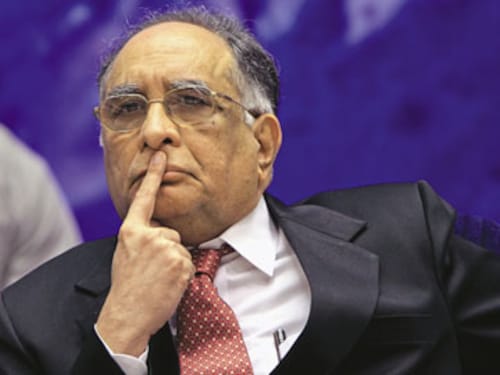
Sarosh Homi Kapadia
Age: 64
Profile: Chief Justice of India. In his long legal career, he has served as a lawyer at Bombay Bar, a Bombay High Court Judge, a Special Court Judge, Uttaranchal Chief Justice, Judge Supreme Court
His Achievement
“A judge must inevitably choose to be a little aloof and isolated from the community at large. He should not be in contact with lawyers, individuals or political parties, their leaders or ministers unless it be on purely social occasions,’’ Kapadia said while delivering the MC Setalvad Memorial lecture on Judicial ethics in April 2011.
Since taking over as the Chief Justice on May 12, 2010, Kapadia has worked tirelessly to restore the diminishing dignity and credibility of the Supreme Court as the final forum for justice seekers. With a single stroke of the pen, he stopped reckless mining in Bellary. He disqualified the crucial appointment of Central Vigilance Commissioner (CVC) reminding the prime minister and his government that processes must stand the test of integrity. In the Vodafone case, Kapadia pointed out that laws are not open to unduly liberal interpretations. A corporate lawyer said that the Vodafone judgement reinforced to the world the independence of the country’s judiciary.
In a few days a Constitution Bench headed by Kapadia will decide on the Presidential Reference made to it after the SC quashed 122 telecom licences and asked the government to conduct auctions to allocate natural resources. He is also expected to frame guidelines for the media on reporting on matters that are being heard in court.
Chief Justice Kapadia will be remembered for some of the landmark judgements he delivered. And the way he lived as a judge will never be forgotten. It can only be called exemplary. In a now famous and widely quoted letter that he wrote to former Justice VR Krishna Iyer, Kapadia said: “I come from a poor family. I started my career as a class IV employee and the only asset I possess is integrity...’’
Early days
The destiny of Sarosh Homi Kapadia was uncertain when he was born on September 29, 1947 in a nation that came into existence barely six weeks before him. Not many people in the world who watched the birth of India gave it a chance as a democracy. The odds were stacked against Kapadia at birth because unlike the illustrious Parsis of Bombay, his father had grown up in a Surat orphanage and had worked as a lowly defense clerk. His mother Katy was a homemaker. The family could barely make ends meet but that did not weaken their robust values.
“My father taught me not to accept obligations from anyone, and my mother taught me the ethical morality of life,’’ Kapadia recalled at a Bombay Parsi Panchayet felicitation when he became CJI. Young Sarosh, however, had decided that he would make his own destiny. He wanted to become a judge and nothing else.
At the felicitation, Panchayet trustee Khojeste Mistree talked about his student days. Kapadia would walk down Narayan Dhabolkar Road in Mumbai, past the Rocky Hill flats, where a number of judges lived, and dream that one day he would progress from being an advocate to becoming a judge and have the honour of living in those very same salubrious surroundings, Parsi Khabar, an online community web site, reported Mistree as saying.
Many years later, when Kapadia became a judge at the Bombay High Court, he always sat in court room number three on the ground floor, which perplexed many because as judges rose in seniority they also moved up the courthouse building. Kapadia revealed the reason why he was fond of the room when he was invited to tea at the Bar just before taking over as the Chief Justice of the Uttaranchal High Court in 2003. Early in his career as a low-grade employee, he used to end up at the Fountain area near the court for work. He didn’t have anywhere to go to spend his lunch break. For three years lunch often used to be a small cone of roasted chana (gram) and courtroom number three was the place to relax because it let in good breeze. A lawyer in Mumbai who was present says that Kapadia recalled how his interest in law was fuelled by the sessions in that courtroom.
Kapadia began his career as a grade four employee with Behramjee Jeejeebhoy where his main job was to deliver case briefs to lawyers. Behramjee Jeejeebhoy was the owner of seven villages in Bombay and had a lot of land revenue as well as a number of land-related disputes to settle. Those cases were handled by Gagrat and Company where a young lawyer, Ratnakar D Sulakhe, used to work.
“Sarosh used to come very regularly to our offices. That is how I first met him. He had a keen interest in law and I encouraged him to take it up,’’ remembers Sulakhe, who is now legal consultant with the Godrej group.
Kapadia studied law and enrolled at the bar. By that time he had a keen grasp of issues related to land and revenue and began taking up such cases. As a junior lawyer, he quickly gained a reputation for his preparation and ability to cite authority while arguing. Kapadia then joined Feroze Damania, a feisty labour lawyer reputed to be partial to poor and marginalised people.
In 1982, Kapadia argued a case for people living in Ghatkopar, a suburb in Mumbai. The area was formerly salt pans and fell under the control of the Salt Commissioner. The commissioner had ordered summary eviction of about 3,000 tenements. Kapadia fought the case which resulted in a landmark judgement laying down the principle that governments cannot invoke summary eviction laws to throw out people when there is a genuine dispute on the title.
“It was not about money. He was genuinely interested in the welfare of marginalised people,’’ a colleague who worked with him at Damania’s offices told Forbes India. He did not wish to be named.
The colleague says, at the time Kapadia became interested in Buddhist and Hindu philosophies, especially in the teachings of Ramana Maharishi, Swami Vivekananda and Ramakrishna Paramahansa. Later he became a frequent visitor to Belur Math on the banks of the Hoogly in Kolkata. A monk at the Math says he learnt meditation techniques. He has read everything about Ramakrishna and also what Swami Vivekananda wrote.
Kapadia’s worldview is highly influenced by Indian thinkers but is also tempered by the observed realities of the modern world. It has also shaped his thinking as a judge who believes in continuous learning.
“What we need today in India as far as the judges are concerned is a scholastic living,” Kapadia said in December 2008. Delivering the JK Mathur memorial lecture in Lucknow, Kapadia went on to define the context of modern day justice and the legal profession. In that speech he said how important it was for judges to understand the various concepts in different fields, including economics and accountancy. Kapadia himself is a qualified accountant and has vast knowledge of economics. That came in handy in a case where Orissa’s tribals were pitted against a miner.
There were no jobs, hospitals or schools in the area the company wanted to mine. Kapadia analysed the accounts of the company to find out whether it could set aside a portion of profits for tribals’ welfare. He dissected the accounts segment-wise to discover a profit of about Rs 500 crore when without the standard of accounting the profit would be only Rs 15 crore.
“A judge sitting in tax matters knows the accounting standards. It helps us to decide matters in the context of socio-economic justice enshrined in the Constitution… This is where I emphasise the knowledge of the basic concepts.’’
A Mumbai lawyer who knows him from the time Kapadia was a lawyer and later judge, says that he has evolved into a complete jurist. Yet, the Chief Justice has not stopped learning.
In July 2011, the Supreme Court gave a verdict in a case involving limestone mining in Meghalaya’s East Khasi Hills by Franco-Spanish cement company Lafarge Umiam Mining. Almost a year-and-a-half before that, the company had been asked to stop mining by a Bench headed by Justice KG Balakrishnan. When the hearing resumed, Justice Balakrishnan had retired and Kapadia was presiding on the three-judge bench.
As Harish Salve began to argue for Lafarge, Kapadia realised that he did not know enough background. So he asked the senior lawyer to brief the court on the history of environmental jurisprudence. A stumped Salve said that would be like reading a textbook. To which Kapadia replied that he was a Bombay man who understood very little about environmental matters and would Salve not help the court? Every Friday for the next seven weeks the cavernous courtroom turned into a classroom where Salve elaborated on the evolution of environmental jurisprudence in India.
Unshakeable Integrity
There are two qualities of Justice Kapadia that no one disputes— integrity and compassion.
“His humble beginnings are reflected in his outlook and judgements,’’ says senior lawyer Soli Sorabjee. “A litigant may feel disappointed if he loses the case but no litigant goes back [from Kapadia’s court] feeling he was not fairly or fully heard.’’
In his pursuit of flawless integrity, Kapadia has hermetically sealed himself. He even said in a speech that judges and lawyers should work like a horse and live like a hermit. When Forbes India sought to interview him for this profile, the CJ’s office said the strict code of conduct binding Supreme Court judges does not allow him to agree. Kapadia’s personal code of conduct is more severe. Retired Justice VR Krishna Iyer told Forbes India that he had gathered from his colleagues that he was too dignified to even meet other judges, rarely meets anybody at random and when he speaks he is taciturn.
Kapadia does not accept even official invitations if they fall on a working day. He once rejected an invitation to represent India at a conference of the Commonwealth Law Association in Hyderabad because it fell on a working day. On the first day in office as CJI, he cleared 39 matters in half an hour. Kapadia has practically dedicated his life to the profession, rarely taking holidays even.
During the first summer holidays after he became chief justice, Kapadia is said to have come to office everyday to streamline the SC registry.
According to several lawyers, the registry had deteriorated into a corrupt office where ‘bench hunting’ was common. Bench hunting is gaming the allocation process to make sure that a certain matter appears before a certain judge who the lawyer thinks will rule in a particular way. Kapadia has put an end to it and is now said to review the day’s board of case listings and pull up the SC staff if he finds something amiss.
The CJ has also stopped out-of-turn mentioning of cases to be taken up urgently, which has caused some consternation among lawyers. Earlier, lawyers could request the judge while the court was in session to take up an unlisted matter because it was urgent. Now they have to file an urgency petition a day in advance. The system exists because there is a mountain of pending cases in the judicial system. And since the SC is the final authority, it gets overburdened. “It will not be long before we have a 100 judges in the SC,’’ says a lawyer. The SC currently has 30 judges, excluding the CJI.
The Indian justice system had drawn a lot of flak over the past few years after the integrity of several past and sitting judges was questioned. But Kapadia defended the system in his Law Day speech last November.
“I am an optimist. I do not share the impression that judicial system has collapsed or is fast collapsing. I strongly believe and maintain that with all the drawbacks and limitations with shortage of resources and capacity, we still have a time-tested system,’’ he said. He also said that the backlog of cases is not as huge as is made out to be. “Seventy-four percent of the cases are less than five years old,’’ he said and added that the focus is on quickly disposing of the rest of the cases.
Kapadia has certainly restored the confidence and pride in the Supreme Court of India.
“He will certainly be remembered for the landmark Vodafone decision,’’ says Percy Billimoria, senior partner at corporate law firm AZB and Partners. “Whenever anyone complains about the retrospective amendment of the tax law on this issue, I always retort by reminding them that the fact that the decision held that the government’s stand on a matter with such far reaching revenue implications was contrary to the law at the time shows that at least our judiciary is fair and independent.’’
By the time Kapadia hangs up his cloak and collar on September 29, he would have left an indelible mark on India’s judicial history. Former Justice VR Krishna Iyer told Forbes India: “While I have seen during the last 97 years of my life among good judges with great credentials, there was hardly anyone to compare with Kapadia the like of which no eye had seen, no heart conceived and no human tongue can adequately tell.’’
First Published: Aug 21, 2012, 06:08
Subscribe Now