IIM-A Needs to Step Out Into the Real World
The country's foremost management institute needs a whole new business model. Now!
Last Updated: Sep 10, 2012, 06:37 IST23 min
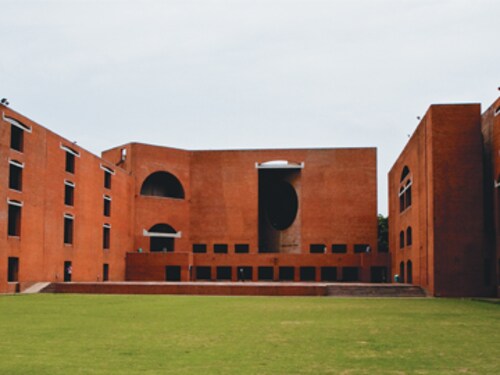
The weather in Ahmedabad was playing the perfect host on December 10, 2011. It was the last day of the golden jubilee celebrations of the Indian Institute of Management, Ahmedabad, the best business school in the country. The Louis Kahn Plaza was full with professors and alumni who had come from all over the world, who after a two-day tango with nostalgia and foxtrot with the future, were looking for relief. That’s when the headline act of the evening appeared in a metallic blue salwar kameez, the first strains of Raga Bhoopali (Mohanam) accompanying her to the stage. “I never thought I would return one day here in this way—to sing for you,” she said.
Chandrika Krishnamurthy Tandon is the first woman of Indian origin to become a partner at McKinsey. She is Pepsico chief Indra Nooyi’s elder sister, and graduated from the institute in 1975. Tandon was at the campus after three decades to perform her 2010 Grammy nominated song Om Namo Narayanaya. As her clear mezzo-soprano voice soared first with Vakratunda Mahakaya and later with Om Namo Naraynanaya, for once the congregation seemed at peace. The uneasy relationship of the past years between the alumni and the professors seemed distant.
But she did something even more long lasting. The next day Atanu Ghosh, who was then the go-to man at the institute for alumni relations, announced that she had committed to contribute $1 million to her alma mater to a chair for entrepreneurship. That started off the giving. Naukri’s Sanjeev Bikhchandani, Eklavya Education Foundation’s Sunil Handa, and Orchid Pharmaceuticals’ Raghavendra Rao gave almost Rs 10 crore each, with other alumni chipping in with another Rs 8-10 crore. All this amount would come to the institute over four years. This was perhaps the largest pool of contribution given to the institute since its formative years in the early sixties.
Why does an institute with such an array of alumni have to wait so long for this? “It was a heart searing moment for me to come back and have KV Kamath, Harsha Bhogle and so many eminent alumni from so many fields in the audience that day. When I looked there I just saw immense possibilities for the institute. I had wanted to contribute for such a long time—guru dakshina—but did not know who to approach. And nobody ever asked,” says Tandon.
The isolation of the austere campus at Vastrapur, Ahmedabad, may foster a great intellectual atmosphere, but IIM Ahmedabad (IIM-A) and its professors know that winds of change are blowing all round it. Global Business Schools want to eat its lunch. Newly opened IIMs and other B-Schools want to snag its prized faculty. Five of the new IIMs have IIM-A professors as their directors.
The world of business itself is changing rapidly. Capitalism and its crises call out for a new improved economic system. Corporations around the world are required to focus much more on sustainability. Businesses are seen as being subject to societal obligations. India Inc needs new answers to survive and grow in a globalised world. And India needs IIM-A to showcase its thought leadership in public debate, in doing ground-breaking work on its inchoate but very promising economy. IIM-A needs to do more than what it does so well—teach students or be on policy making bodies. It needs to change.
Change is hard but it is hardest for those who are the best in their business and IIM-A is one for sure.
THE MAN WITH A PLAN?
AM Naik is an unlikely man, one would imagine, to understand what IIM needs. He is, after all, not an MBA. He does not have a long association with the academic world, though, to be fair, he does come from a family of teachers. But ever since he was appointed as the chairman of the board of governors of IIM-A in late April, he has been trying to shake things up a bit. The current director Samir Barua’s term comes to an end in September 2012. In his last meeting as chairman, Vijaypat Singhania had formed a search committee for the new director of IIM-A. After he took charge, the first thing that Naik did was to reconstitute the search committee. Prafull Anubhai, who was associated with IIM-A for more than 40 years, was left out of the committee—and Naik himself decided to chair it.
Given his experiences over the last decade at L&T, he probably knows an organisation ripe for reinvention when he sees such an entity.
When Naik took over L&T way back in 1999, it was a behemoth where seniority mattered more than performance. This meant that bright young people left the group to try their luck elsewhere. Its stock price was languishing and it was twice a takeover target. Naik has since then been able to create a group that has much more synergy, is far more performance oriented and has been able to open up international markets to hedge its business against slowdown in any one market.
He could perhaps take a leaf out of the approach Mukesh Ambani has used at IIM Bangalore to get things moving in spite of government control. As chairman, Ambani is said to have teamed up well with Director Prakash Apte and more recently, Pankaj Chandra, to help the research agenda. For one, IIM-B has been particularly successful in attracting relatively younger faculty with doctoral degrees from top universities such as MIT, Wharton, Cornell, INSEAD and John Hopkins. Besides, faculty has been clearly incentivised to do more research. None of this has been without its share of controversy. But thanks to the strong, decisive leadership shown by both the director and the board of governors, the fresh blood has succeeded, to some extent, in creating their own space, despite a lot of heartburn inside faculty rooms.
As Trilochan Sastry, professor, IIM-B, says, “The biggest difference between IIMs and foreign B-Schools is that in the US they are competing for students, whereas in India we are competing for faculty. Government is not a challenge in getting this talent, neither are salaries. It is how you manage the whole process of recruitment. You have to respond very quickly to these applicants because if you delay things, they get picked up very fast. The other is, what kind of academic environment are you willing to provide? Having said that, we do need to improve faculty salaries.”
Naik too realises that the forthcoming appointment of the new director may be one of the most critical decisions in the history of IIM-A. In the last 10 years, two past directors—Bakul Dholakia (2002-2007) and Samir Barua (2007-2012)—have tried to take the institute away from the iron chains of the government but they haven’t been able to take it to a place where IIM-A is free to chart its own destiny.
Insiders privy to the selection process say that almost 50 professors of Indian origin have been contacted by the search committee. That includes Harvard don Srikant Datar. Datar has expressed his unwillingness to take up the assignment as he is too committed at Harvard Business School. And almost 95 percent of the candidates that the search committee has contacted have not been very enthusiastic. Partly it is the salary. The maximum the institute can offer them is Rs 60 lakh. Most top professors make at least four times that amount in the US. Since candidates aren’t biting, there are talks that the search process may even get extended by a month or so.
So, while Naik may pull out all stops, the fact is that it isn’t going to be easy for him. If IIM-A has to go to the next level, it will need someone not afraid to take bold decisions. Someone who knows how to preserve the things that work, but replace those that don’t. Naik will understand. He has been all of that in L&T’s context. “The idea is to take a great institution and make it even better,” he says.
THE ARRIVAL OF COMPETITION
So what are these bold decisions? The one big thing will be to tackle the—hate to use to the phrase—business model of the institute. The current method, in which the institute is funding its operations by cranking out multifarious programmes, is reaching its natural limit given the constraints on faculty.
The second big decision would be to create a culture that encourages professors to come up with ideas that can invade the world of business—or research, in plain English. That will need a series of decisions that can free up a professor’s time, create incentives that reward research and ensure that the feelings of those who want to maintain focus on teaching aren’t hurt, and also attract talent from across the world.
But more importantly, the new director will need to understand business school education the way the global leader Harvard Business School and IIM-A’s India challenger, the Indian School of Business (ISB), Hyderabad, understand it.
There is no better place to understand the nature of global competition than the Taj Land’s End Hotel in Mumbai. As you take the lift up to the coffee shop, you see a signboard that guides you to Harvard’s replica of its Boston Classroom. For the last few months, Harvard has been using this outpost to grab a share of the highly lucrative Rs 350 crore senior executive management education opportunity. About six years ago, Harvard had set up the India Research Centre with the help of Mahindra Group to develop case material based on Indian companies and experiences.
Though Harvard may be the most active, Wharton, University of Chicago, Tuck School, INSEAD and MISB Bocconi all want a slice of this market. They have developed their own research to back it up. Wharton offers the research work of its Indian Way for its executive education, Tuck School offers the Reverse Innovation course and INSEAD has the Top Indian CEOs.
“The global B-Schools know that the biggest income generator from business education courses comes from executive education. The entry-level MBA course usually doesn’t make money,” says Pramath Sinha, founder and managing director, 9.9 Mediaworx, who was the founding dean at ISB. While IIM-A’s own management development programme (MDP) too has seen rise in enrolment, it is usually the slightly less paying middle-management that utilises it.
While global B-School’s are trying to steal the cream, ISB, 11 years old, is busy trying to capitalise on IIM-A’s limited capabilities in increasing its intake. IIM-A has increased its entry-level MBA intake to 300 a year from 180 over the last decade ISB is going to crank out 800 students a year now (possibly 1,100 in a few years) from its Hyderabad and Mohali campuses.
“In 50 years, IIM-A has around 14,000 to 15,000 alumni. ISB will have almost 7,000 to 8,000 in just 10 years of existence. And with their second campus that pace is just going to increase. At IIM-A, we clearly have to think hard about what this means for us,” says Arvind Sahay, marketing faculty, IIM-A. It may be counter-intuitive, but for a reputed institute, scale drives reputation. Most US B-Schools have a class-size that is larger than 500, except Stanford. This is because as employers see alumni from an institute at different places, they feel comfortable that the hire they made from that institute wasn’t an experimental choice. It gives them the comfort that others too see value in graduates from that institute.
So the best institute in India is now at the centre of a pincer movement. It has global B-Schools to fight for high-paying executive education. Since it can’t scale up its class size because of faculty constraints, many people don’t get into IIM-A. Very often these candidates prefer to work and join an institute that gives weightage to that experience.
Remember, IIM-A even today can take in only 0.5 percent of the people that want admission into its hallowed portal. “Assuming that 10 percent of those taking the test are as bright as those IIM-A takes, many who don’t get in prefer to work for a few years and then seek admission in an ISB or other global schools,” says Bakul Dholakia, former director, IIM-A, who is currently the director of Adani Institute of Infrastructure Management. It was during his tenure that IIM launched the one-year PGPX programme, perhaps the one successful “new product” to come from IIM in the last 20 years.
THE LIMITATIONS OF THE CURRENT APPROACH
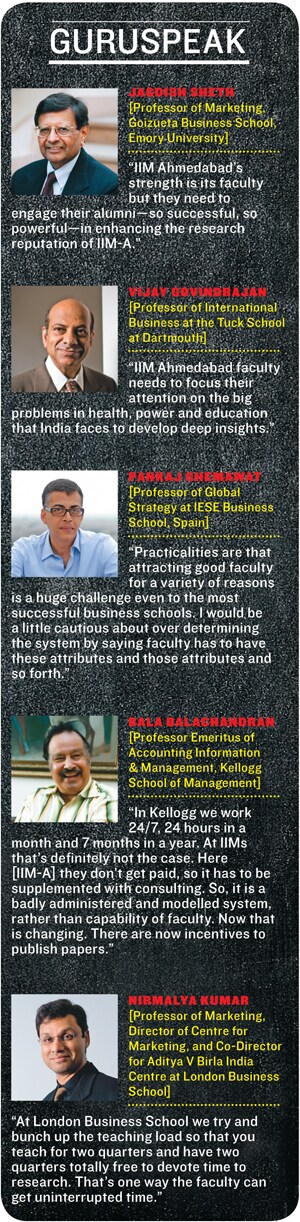
So how can IIM-A respond? Can’t it launch a slew of courses aimed at senior executives in top Indian corporations? Top executives tend to listen more carefully when someone can tell them a few things about their business that they themselves don’t fully understand. This is global management guru territory. This is what someone like Ram Charan does for a living. The other way to attract senior executives is through ideas or path-breaking research. That was the territory of Sumantra Ghoshal and CK Prahalad. That’s what Pankaj Ghemawat, Jagdish Sheth, or Nirmalya Kumar do.
But here is the irony: If teaching is indeed its forte, can IIM-A handle the pressure of increasing the size of its MBA programme? Over the past five years, the faculty strength has hovered around 85. “Ideally, IIM-A should try and expand it to 120,” says Dholakia. ISB, for instance, has been able to take its own faculty size to 50, besides relying on a steady stream of part-time professors from abroad.
The problem is that IIM-A has been reactive, allowing external events to drive it to change. First it was Murli Manohar Joshi’s HRD ministry, in 2002, that threatened to cut its fees, withdraw the grant, if IIM-A did not sign a new memorandum of association. Dholakia, who was then the director, stood up to the pressure. “I told the ministry that we will generate our own resources and would not need the grant,” he says. His solution was to increase the number of students that IIM-A accepted and raise the fees. He also introduced a one-year PGPX course to grab a sliver of the market for experienced MBA seekers.
The next external stimulus for change came when the Supreme Court ordered the implementation of OBC quota of 27 percent in educational institutions, including all the IIMs. This forced the IIMs to expand class size and increase fees once again. Today, an IIM class size is 60 percent higher than what it was a decade ago. And the fees have gone up from Rs 4 lakh to almost Rs 15 lakh.
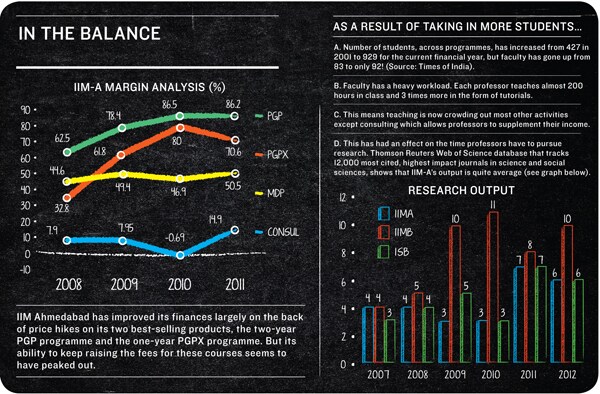
It is now fairly clear that IIM-A may have milked the cash cow for all its worth. Its gross profit margin on the entry-level MBA, referred to internally as the Post Graduate Program (PGP), is 86 percent. The gross margin on PGPX, the one-year course, is 70 percent (see graphic). To raise prices even more will be very difficult. “There is a limit to what price we can charge for the courses. It depends on the loans banks give to an IIM candidate and the salary that our students will get. We cannot keep increasing the price,” says Samir Barua, director, IIM-A.
There is a limit to the faculty time as well. The student intake has increased and faculty strength has not. “In 2000-01, there was one faculty member for every five students. Today, there is one faculty member for every 10 students. Between 2000-01 and 2012-13, the number of students has gone up by 117 percent. Against this, the faculty strength has increased by just about 10 percent,” says a recent Times of India article.
The lack of faculty means increased teaching workload. The contact hours per student are now close to 875 hours annually. Of this, IIM professors teach roughly 200 hours inside the classroom (it’s 120 hours per faculty at leading global B-Schools). The rest are spent in preparatory courses for students, called tutorials. This is because students are without any work experience and need much more teaching to deserve their IIM-A branding.
Then there are executive education programmes too. The more the professors teach, the less time they have for consulting and research. Of the two, most choose consulting. “It is natural to find faculty supplementing their income with consulting projects,” says Dholakia.
THE FUTURE IS ALUMNI
This hasn’t deterred IIM-A from dreaming big. Three months ago, a new faculty performance evaluation system was unveiled at IIM-A. “The new system gives much more weightage to our faculty publishing research in high-quality, peer-reviewed journals,” says Barua.
That culture will not come because of a change in incentive. It will come if the institute has enough money to hire more faculty, and free up its time to devote to research. It will come only if IIM-A is willing to ask itself a prickly question: “Why is Harvard the No 1 university in the world?”
This is exactly the question that Shailendra Mehta, professor of business policy at IIM-A, has answered in a research paper called ‘Why is Harvard Number #1 University in the World’. Mehta’s research shows that India invented the concept of the university. For the next 2,000 years nobody had universities better than India. Then Europe added two more and later the USA added a couple. Generally, universities take 100 to 200 years to become good, so why did so many US universities—Stanford, Duke, Carnegie Mellon, Chicago—join the front ranks quickly? For the last 50 years, 70 percent of the top universities in the world have been in the US.
The answer is alumni control, says Mehta. Almost all top US universities give enormous control to the alumni. At Harvard, Princeton, Yale and Columbia, more than 90 percent of the board of trustees is formed by alumni. Nobody values an institution more than those who have studied there. Their career prospects and a lot of what they do can be traced back to the institution at which they studied. It stands to reason that when they are given a large say in the running of the institute, they take decisions that are good for the institution in the long run. And they also bring in the money.
For 2011, Harvard’s endowment was $31 billion in size. Yale had an endowment of $19 billion. Princeton and Stanford have an endowment of $17 billion and $16 billion, respectively.
That’s what allows them to hire great faculty and also to give them enough time to do research that leads to path-breaking ideas.
At IIM-A, this is a treacherous territory. At one level, it has undoubtedly powerful alumni. A recent study showed nearly half of India Inc’s CEOs hail from either an IIT or an IIM.
Out of the four elite IIMs—Ahmedabad, Bangalore, Calcutta and Lucknow—IIM-A produces the largest proportion of CEOs, at a whopping 62 percent.
On the other hand, a lot of professors talk about how the alumni don’t care. Or they say that the alumni make insulting demands. One faculty member spoke about how an alumnus, for giving Rs 1 lakh in donation, wanted him and his spouse to be invited to the campus and a citation to be read out for their kind act. He also wanted a periodic report on the usage of the money. Naturally, the IIM-A faculty is wary of reaching out to its alumni.
But this is incomplete reasoning. This happens because there is no structured approach to reach out to the alumni. It is a hit-and-miss affair. “You certainly can’t have the director making these phone calls to the alumni,” says Naik. And most alumni understand that the faculty needs to be shielded from such tasks. “Many US universities have a development officer whose job it is to handle this interaction with the alumni. I totally agree that the faculty should be spared from these tasks,” says Chandrika Tandon.
And IIM-A would know that if one emotional event, the Golden Jubilee celebrations, could bring Rs 40 crore, surely a regular reaching out will bring in more money.
This is something ISB has been able to achieve. It has had the benefit of some healthy donations by wealthy individuals and that has helped it hire more faculty members and keep the teaching load of an ISB professor at a globally acceptable level. “For the first three years, the teaching load is just 80 hours. Then it increases to 120 hours,” says Ajit Rangnekar, dean, ISB.
ISB also ensures that usually the faculty teaches only one course so that the preparation time to take those courses comes down.
While money goes a long way, it isn’t the only thing. The move to a more research-led culture also requires the faculty to admit that there is life beyond teaching. “You have to believe that creating new ideas is important. And the person who comes up with the new ideas will get paid more than someone who merely teaches,” says Nirmalya Kumar, professor of marketing, director of Centre for Marketing, and co-director for Aditya V Birla India Centre at London Business School.
This, of course, challenges the current culture of IIM-A. Changing that culture will not be easy. Because the faculty have came up in a certain way and are good at teaching. So, they will continue to teach. “One can argue that a new set of research-oriented, young professors can be brought in, but who will select them? It’s the existing faculty, who tend to lean towards teaching than towards research. And as a result, you end up getting younger professors too, who are oriented towards teaching,” says a former IIM-A professor.
A new firebrand director could help change the status quo. But for that, Naik and his team may have to find no less than a transformational leader of the calibre of Ravi Mathai. He was the son of John Mathai, the finance minister in Nehru’s cabinet, and a rank outsider to the world of academics.
Mathai was the managing director of a leading tea company in Kolkata. After quitting his high-paying corporate job, Mathai had just started teaching at IIM-C. In 1965, Vikram Sarabhai, the then honorary director of IIM-A, heard about the impressive 44-year-old and hand-picked him as the first full-time director of IIM-A.
In his six-year term, Mathai left an indelible imprint on the future of the institute and virtually laid the foundations for its meteoric rise. “Heads of institutions fade into oblivion within weeks of demitting office. Mathai is remembered at IIM-A all the time,” wrote TT Ram Mohan, author of the book Brick by Red Brick, in The Economic Times.
So, here’s the moot point: Can Naik and his team on IIM-A’s board of governors do what Sarabhai did? Can they spot an institution builder like Mathai to take IIM-A to the next level? The future of India’s best management institute could well depend on that.
(Additional reporting by NS Ramnath and Mitu Jayashankar)
How Chinese B-Schools Do It
Top-notch research output and getting in the best faculty are the key
By Neelima Mahajan-Bansal
The biggest factor that distinguishes top Indian B-Schools (with the exception of ISB, Hyderabad) from the ones in China is the level of ambition. One would think that Chinese B-Schools would first establish themselves in the home country, get a reputation, and then expand elsewhere in the Asia-Pacific. While that is true to an extent, the top schools are increasingly viewing the developed world as their target market, and the likes of Harvard, Wharton and Stanford as peers. They see themselves in the elite group and will do whatever it takes to equip themselves to compete with the best. As professors from these schools put it, earlier management education models flowed from the West to the East, but now they will flow from the East to the West.
So, the top Chinese schools set the bar high. Their campuses and curriculum have to be world class. They will partner with only the best in the world. And the research output—and faculty—has to be top-notch.
The last point is the most important—and also the toughest to crack. Traditionally, China does not have a history of high-quality management education and PhD programmes in management. So where does the faculty come from? The answer lies in cherry-picking high-quality tenured-track faculty from top global B-Schools. Take for instance the Beijing-based Cheung Kong Graduate School of Business (CKGSB) which will complete a decade of its existence in November, and whose alumni sits at the helm of some of China’s most-valuable brands.
CKGSB has managed this feat in less than 10 years. It has attracted 32 full-time tenured-track professors and 15 visiting and adjunct faculty from Stanford, Yale, MIT, Wharton and UCLA, among others. The plan is to double the faculty size over the next 10 years. The school has set up offices in New York, London and Hong Kong, apart from satellite campuses in Chinese cities such as Shanghai and Shenzhen. And it offers courses around the world on its own and in conjunction with the world’s best B-Schools such as Columbia Graduate School of Business, and Judge School of Business at Cambridge University.
How does the school manage to do this? B-School deans all over the world will tell you that the biggest factor in attracting high-quality faculty is the ability to provide an enabling research environment. The number of research centres and research output is an important measure of a school’s quality. Compared to Indian schools which tend to be stingy with research funding (and slow with approvals of research projects), Chinese schools readily support research with monetary resources, and by setting up research centres. It also helps that China is seen as the world’s laboratory for business model innovation. There is a lot of curiosity about the so-called emerging giants coming out of China—Lenovo, Huawei, Alibaba, Baidu.
CKGSB operates on a unique faculty-governed model, which gives professors a say in everything the school does. They decide on the direction the school should take, unlike most other schools where decision-making is top-down.
This is an important non-monetary incentive for faculty. Tie that in with monetary compensation. The top Chinese schools give faculty financial incentives which are at par with the top North American schools.
All of this is possible because the top schools have deep pockets. CKGSB, for instance, is funded by the Li Ka Shing Foundation, which was established by business tycoon Li Ka-shing. Across schools, alumni are increasingly starting to give back to their alma mater, something that’s sorely missing in Indian schools.
The author is Senior Editor, Knowledge Center, CKGSB, Beijing. The views expressed in this article are those of the author.
First Published: Sep 10, 2012, 06:37
Subscribe Now